
Quick Summary
A Healthcare Robot is changing how hospitals, clinics, diagnostic centers, and public health systems deliver care. Instead of limiting services to fixed rooms, manual workflows, and staff-heavy processes, robotics helps healthcare providers improve speed, consistency, access, and data visibility. From patient screening and diagnostics to medicine delivery and teleconsultation, robots now support clinical teams in practical, measurable ways. For healthcare leaders, the real question is not whether robotics belongs in care delivery. The real question is where robotics can remove friction, reduce dependency on repetitive manual work, and improve the patient experience without increasing operational burden.
The healthcare industry runs on accuracy, timing, and continuity. Every missed reading, delayed screening, or overloaded staff queue has a direct effect on patient outcomes and service quality. A robotic system enters that environment as a structured support system. Robotics helps care teams standardize repetitive tasks, expand service availability, and maintain better screening consistency across locations.
When healthcare organizations think about robots, many still imagine only surgery or futuristic machines in advanced hospitals. The reality is much broader. A robot can support first-level health screening, patient guidance, diagnostic workflows, internal transport, sanitation, pharmacy support, elderly care, and remote consultation. In a sector where demand keeps rising and trained manpower remains limited, robotics gives providers a way to serve more people without compromising process control.
What Makes Healthcare Robotics Relevant in Modern Care Delivery
Healthcare systems face pressure from every direction. Patient footfall is increasing. Preventive screening programs need wider reach. Staff burnout affects consistency. Rural and semi-urban areas still struggle with access. At the same time, healthcare leaders are expected to improve care quality, maintain documentation, and make faster operational decisions.
A Healthcare Robot becomes relevant because it supports healthcare delivery at the point where routine work and clinical efficiency meet. Doctors, nurses, and technicians still lead care. Robotics handles the structured, repeatable, high-frequency parts of care delivery that often slow teams down. A clinician’s time should go to interpretation, treatment, and patient judgment, not to repetitive, operator-dependent screening flow.
Consider a standard outpatient environment. Registration takes time. Patients wait for vital checks. Staff move between stations. Reports are delayed because readings come from different devices and different people. The entire process becomes fragmented. A robotic system reduces fragmentation. The unit can guide the user, collect measurements in sequence, consolidate data, and generate results faster, which helps the care team move to the next clinical step with better clarity.
How Are Robots Used at the First Point of Care
One of the most practical uses of a Healthcare Robot is at the first point of care, where speed and consistency matter most. Hospitals, diagnostic centers, and community health programs often need a structured method to capture early health indicators before a doctor consultation begins. That stage includes temperature, blood pressure, oxygen saturation, BMI, glucose-related checks, ECG, spirometry, and other basic or semi-advanced assessments depending on the setup.
A robotic screening workflow helps organizations turn disconnected checks into one guided process. Instead of sending a person from desk to desk, the robot can guide the session, connect multiple diagnostic modules, and produce a consolidated report. That saves time for the patient and reduces coordination load for the facility.
For high-footfall environments, a linked Health Screening Robot also improves throughput. A patient can complete screening in one place, receive digital results, and move to the next clinical step without long administrative delays. The value becomes even stronger when the same model is deployed across multiple branches because every location follows the same workflow and captures data in the same format.
How Are Robots Used in Diagnostics and Preventive Screening
Preventive healthcare depends on early detection. The challenge is not the importance of screening. The challenge is making screening frequent, accessible, and operationally manageable. Robotic screening helps solve that challenge by bringing structured diagnostics into places where traditional infrastructure creates delays or cost barriers.
Diagnostic centers can use robotic systems to run guided screening packages with less operator dependency. Corporate wellness programs can use robotics for routine workforce screening. Hospitals can place such systems in OPD or pre-check environments to reduce manual load. Public health teams can use them in transport hubs, community camps, and semi-urban facilities where fast, repeatable assessments are needed.
The biggest strength here is standardization. Manual screening quality often depends on who is present, how busy the team is, and whether the same sequence is followed each time. Robotics improves process reliability. The patient journey remains guided. Data capture stays structured. Reports remain consistent. For organizations managing preventive programs at scale, operational consistency matters as much as the screening itself.
How Are Robots Used in Surgery and Clinical Assistance
Surgical robotics is one of the most visible examples of how a Healthcare Robot supports advanced care. In surgery, robotic systems help clinicians perform precise movements through minimally invasive techniques. A surgeon remains in control, but the robotic platform improves stability, dexterity, and visualization during complex procedures.
The value of robotic assistance in surgery is not only precision. Robotic support can also enable smaller incisions, more controlled movements, and better access in procedures that require delicate navigation. For hospitals, such systems can become part of a strategy to improve outcomes in selected specialties, strengthen surgical capability, and attract patients seeking advanced treatment pathways.
Clinical assistance also extends beyond the operating room. Some robotic systems help with rehabilitation exercises, mobility support, or repetitive physical assistance in recovery settings. Others support nursing teams with guided transport or bedside service workflows. The broader point is simple. Robotics is already working inside real care environments, not as an experiment, but as a practical extension of clinical capability.
How Are Robots Used for Hospital Logistics and Internal Operations
A hospital does not run only on doctors and treatment protocols. A hospital also runs on movement. Samples must reach labs. Medicines must reach wards. Linen, supplies, and equipment must move across departments. Staff time is often lost in internal transport, which creates invisible inefficiency across the facility.
A Healthcare Robot used for logistics helps reduce that burden. Autonomous delivery robots can move medicines, reports, lab samples, and supplies from one zone to another while following mapped routes and safety protocols. The task may not look dramatic, yet the operational problem is real and constant.
When repetitive transport shifts away from human staff, nurses and support teams recover time for patient-facing tasks. Delays reduce. Manual dependency drops. Service flow becomes smoother. For larger hospitals and multispecialty campuses, robotics in internal logistics can create measurable operational gains without changing the core clinical model.
How Are Robots Used in Remote Consultation and Connected Care
Healthcare access is not equal across every location. Many patients still face distance, waiting time, and specialist availability issues before they receive guidance. A Healthcare Robot can help bridge part of that access gap when teleconsultation is built into the care journey.
In connected care models, the robot performs the structured screening first and then connects the user to a physician through instant video consultation. Sequence matters because the doctor receives organized pre-check data before the consultation begins. Instead of starting with assumptions, the physician starts with readings, symptoms, and screening markers already captured in a structured format.
For hospitals, clinics, and public programs, such a model creates a stronger first-line care system. Screening and consultation happen in one connected flow. Patients receive direction faster. Reports remain digital. Follow-up becomes easier. The model works especially well in remote areas, workplace health programs, and high-footfall locations where quick triage and guidance are necessary.
How Are Robots Used in Elderly Care and Rehabilitation
Ageing populations create another major use case for robotics in healthcare. Elderly patients often need support with mobility, routine monitoring, reminders, rehabilitation, and assisted interaction. A robotic support system in this setting can provide functional support without reducing the role of caregivers or family members.
Some robots assist with rehabilitation exercises through guided sessions. Others support movement, medication reminders, or communication prompts. In elder care facilities, robotic assistance can reduce repetitive supervision load while improving routine consistency. For patients recovering from surgery or managing long-term conditions, guided robotic support can help improve compliance with therapy plans.
The value here is dignity and continuity. Older adults benefit when support systems are predictable, easy to use, and available without constant dependency on an overburdened staff member. For care providers, robotics can strengthen service quality in settings where continuous manual supervision is difficult to maintain.
How Are Robots Used in Sanitation and Infection Control
Cleanliness is a patient safety issue, not just a housekeeping task. Hospitals manage high-risk environments where contamination control must stay consistent across wards, corridors, ICUs, labs, and waiting areas. Robotics is now playing a practical role in that responsibility.
Autonomous cleaning and disinfection systems help facilities maintain sanitation quality with better coverage and repeatability. The systems can support floor cleaning, targeted disinfection, and routine maintenance in areas where hygiene standards must remain high. The advantage is process discipline. A machine does not skip tasks because of fatigue, distraction, or schedule inconsistency.
A Healthcare Robot in the broader care ecosystem therefore supports more than diagnosis or consultation. Robotics also strengthens the operational layer that protects patients and staff every day. Infection control improves when cleaning becomes measurable, trackable, and less dependent on irregular manual execution.
What Business Value Do Robots Deliver to Healthcare Providers
Healthcare organizations do not invest in robotics for novelty. Organizations invest when a system improves throughput, process control, coverage, or cost efficiency. A Healthcare Robot creates value when it helps leaders solve one or more of the following problems: staff overload, fragmented screening, inconsistent reporting, limited reach, delayed service flow, or poor visibility across locations.
The first business gain is standardization. Robotics creates repeatable workflows across branches, departments, and programs. The second gain is time efficiency. Structured screening, internal transport, or guided interaction reduces avoidable delays. The third gain is data continuity. Digital systems capture results in standardized formats, making it easier to review trends, maintain records, and support preventive decisions.
The fourth gain is scalability. A healthcare provider can extend services into new sites without replicating the full burden of traditional infrastructure at every location. That matters for hospital groups, diagnostic chains, insurers, CSR health programs, and government-backed initiatives. A robot only becomes valuable when it solves real operating friction. In the healthcare industry, plenty of that friction exists.
Why Medigo Fits the Real Use of Robotics in Healthcare
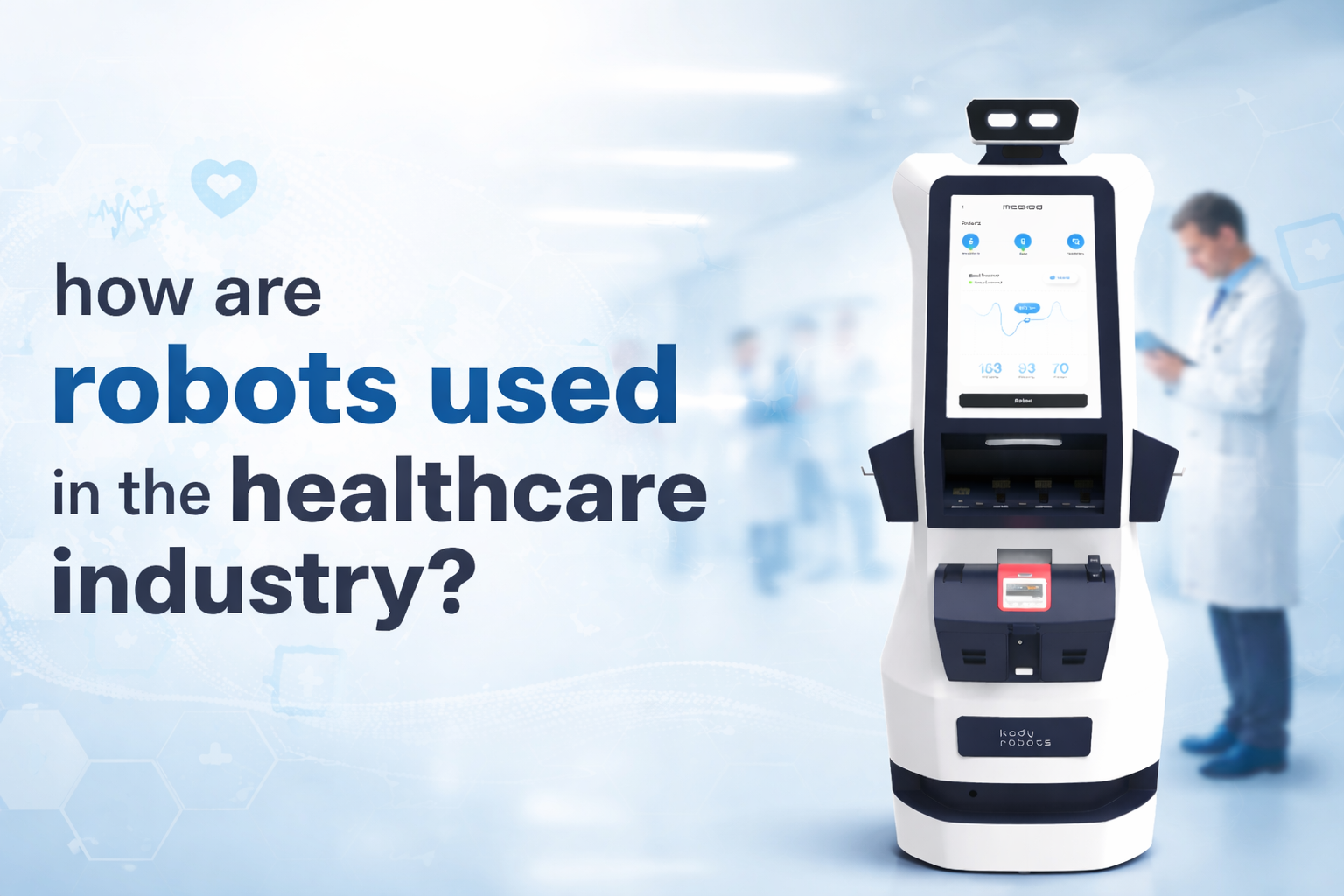
A practical example of this model is Medigo, an AI-powered screening solution developed for structured, multi-parameter health assessment. Medigo shows how a Healthcare Robot can work inside actual care delivery instead of remaining limited to a concept presentation.
Medigo supports guided screening, connected diagnostic devices, digital report generation, searchable screening history, and instant teleconsultation within the same workflow. The system is designed for hospitals, diagnostic centers, workforce health programs, transport hubs, and public health deployments where organizations need repeatable screening without building a full clinic at every touchpoint.
In the middle of that larger healthcare transition, Kody Robots is positioning Medigo as a deployable system that supports preventive care, faster pre-check workflows, and broader screening access. The value lies in how the system combines operational simplicity with clinical screening structure. A user follows the guided flow, completes the required checks, receives a consolidated report, and can move to the next step without fragmented manual coordination.
What Will the Future of Robots in Healthcare Look Like
The future of healthcare robotics will not depend on spectacle. The future will depend on usefulness. Hospitals and healthcare networks will continue adopting systems that reduce repetitive manual work, improve clinical support, and generate better service continuity. The most successful robotic systems will be the ones that fit into care pathways naturally and solve real bottlenecks.
Such robotic systems will likely become more connected, more specialized, and more data-aware over time. Screening robots will integrate better with digital records. Logistics robots will work more closely with hospital operations. Rehabilitation systems will become more adaptive. Teleconsultation-linked systems will improve access where clinician reach is still limited.
The healthcare industry is moving toward models that favor speed, distributed access, and stronger preventive care. Robotics fits that direction because robotics helps providers deliver structured service without tying every process to a fixed room, a fixed person, or a fixed schedule.
Conclusion
The answer to how robots are used in the healthcare industry is broader than many organizations first expect. Robotics now supports screening, diagnostics, surgery, logistics, rehabilitation, connected consultation, and sanitation across real healthcare environments. The strongest value comes from one principle: robots handle structured, repeatable, high-frequency tasks so healthcare professionals can focus on clinical judgment and patient care.
A Healthcare Robot becomes most valuable when it improves consistency, expands reach, and reduces process friction without making care feel mechanical. That is why healthcare providers, diagnostics networks, and public health systems are paying closer attention to deployable, intelligent robotics models. The industry does not need technology for display. The industry needs systems that make care delivery faster, cleaner, more scalable, and easier to manage. Robotics is starting to prove exactly that.
Frequently Asked Questions
What is a healthcare robot in the healthcare industry?
A healthcare robot is a robotic system used to support medical, operational, or preventive care tasks. The system may assist with screening, diagnostics, surgery, transport, rehabilitation, teleconsultation, or sanitation depending on the use case and care setting.
How are robots used in hospitals every day?
Hospitals use robots for patient screening, medicine and sample delivery, surgical assistance, disinfection, and workflow support. Their role is to improve process consistency, save staff time, and strengthen service quality in high-demand environments.
Do robots replace doctors and nurses?
Robots do not replace doctors or nurses. Robots support repetitive, structured, and time-consuming tasks so clinical professionals can spend more time on diagnosis, treatment, and patient interaction.
Why are robots becoming important in preventive healthcare?
Preventive healthcare requires frequent, standardized, and accessible screening. Robots help organizations deliver screening in a guided and repeatable way, generate digital reports faster, and extend services across multiple locations with better process control.
Is Medigo a practical example of healthcare robotics?
Yes. Medigo is a practical example of robotics applied to health screening, connected diagnostics, report generation, and teleconsultation. The system reflects how healthcare providers can use robotics to improve first-level assessment and preventive care delivery.