
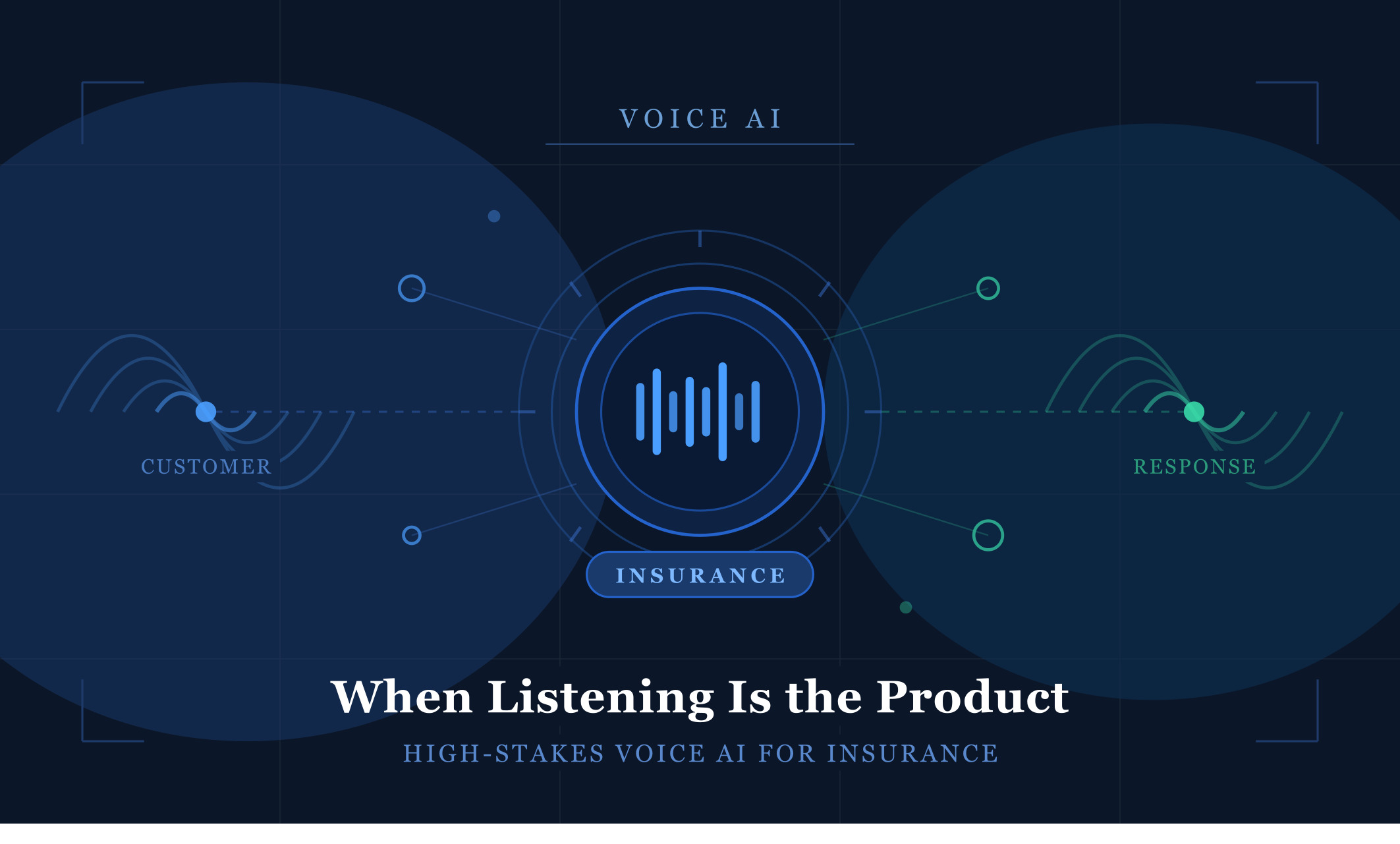
There’s a call happening right now where the customer hasn’t slept in two days. What your AI says and how it listens will decide whether they renew or leave forever.
Insurance companies have spent years optimizing digital forms and chatbots, but the real gap sits in voice. Voice AI for Insurance changes how carriers handle these high-stakes interactions, and a Voice AI Platform built specifically for insurance gives teams a measurable edge in retention and trust.
Insurance Calls Are Emotionally Loaded. Let’s Stop Pretending They’re Not
Most voice AI guides are written as if every customer call is a routine policy inquiry. They’re not. A customer calling after a house fire isn’t looking for efficient IVR routing; they want to feel heard before they get any answers.
Here’s the thing: voice AI trained on insurance-specific language models picks up on hesitation, emotional strain, and urgency cues that a generic assistant will completely miss. And when it catches those signals, it shifts, and the next response comes out slower, plainer, more human.
What “High-Stakes Moment” Actually Means in Insurance
Let’s be specific. A high-stakes customer moment isn’t just a large claim; it could be a first-notice-of-loss call, a coverage dispute, or the call where someone finds out their policy lapsed.
These moments share one thing: the customer’s trust is already fragile before the call even connects. Voice AI that fumbles these interactions doesn’t just lose the call; it accelerates churn in ways that don’t show up until renewal season.
Why Listening Architecture Matters More Than Response Speed
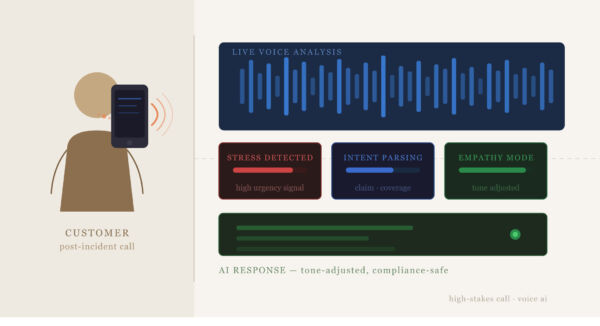
I’ve seen demos where voice AI fires a perfectly accurate answer 0.3 seconds after the customer finishes speaking. The customer still felt dismissed because the AI didn’t pause, didn’t acknowledge, and didn’t breathe.
Listening architecture is about what happens in that gap, how a voice system handles the silence before an answer, the half-finished sentences, the caller who starts over three times. In insurance, getting that gap right is what separates a call that builds trust from one that ends with a complaint.
The AI that wins in insurance isn’t the fastest; it’s the one that sounds like it actually heard you.
Five Things Voice AI Must Get Right on High-Stakes Insurance Calls
- Intent disambiguation under stress: Customers in distress often contradict themselves mid-sentence. The AI needs to hold the most recent stated intent, not the first one.
- Empathy signaling before information delivery: Acknowledging the situation before answering isn’t small talk; it’s what keeps the caller from hanging up.
- Compliance-safe language under pressure: Regulatory language can’t get dropped when a caller pushes back. The AI has to hold the line without sounding robotic.
- Escalation detection with precision: Not every frustrated caller needs a human. The AI should identify actual escalation triggers, legal threats, medical emergencies, and repeat contacts, not just a raised voice.
- Call summarization for handoff: When the call does escalate, the agent receiving it needs a 10-second summary, not a 4-minute recording review.
The Assumption Worth Questioning Here
Most teams assume that faster resolution time equals better customer experience in insurance voice calls. That assumption breaks down quickly when you look at post-call satisfaction data.
A 2023 analysis of insurance call center interactions found that calls rated highest for satisfaction ran 18% longer on average because agents and AI spent more time confirming understanding before moving to resolution. Speed is a metric. Trust is an outcome.
What a Voice AI Platform Built for Insurance Actually Handles
Here’s what separates an insurance-native voice AI setup from a generic deployment:
- Domain-trained language models that understand policy terms, exclusions, endorsements, and state-specific regulatory phrasing
- Sentiment-weighted response adjustment that shifts tone mid-call without requiring a script change
- Native integration with claims systems and policy databases so the AI doesn’t ask for information it already has
- Audit-ready call logging that satisfies both internal compliance teams and external regulators
You don’t bolt these things onto a general-purpose tool after the fact. They have to be built into the platform from the start, because insurance calls carry legal, regulatory, and emotional weight that most industries simply don’t deal with.
Where Voice AI in Insurance Is Actually Headed
The next development isn’t better speech recognition, which is largely solved. What’s coming is longitudinal voice modeling, where the AI recognizes a returning customer’s emotional baseline from prior calls and adjusts accordingly.
Think about what that means: a customer who has always been calm but sounds strained today gets handled differently than one who is characteristically high-energy. That’s not surveillance, that’s a context-aware service. The line matters, and the better platforms are already drawing it carefully.
If you’re evaluating voice AI for insurance, stop asking “how accurate is the transcription?” Start asking how the system behaves when the customer on the other end is genuinely scared.
That’s the call that defines your brand. If you want to see what the right setup looks like for your specific products and call volumes, it’s a conversation worth having.