

The rapid growth of artificial intelligence technologies has significantly influenced the direction of modern IT careers. Organizations across industries are integrating machine learning models, automation systems, and data-driven decision tools into their operations. As a result, professionals entering the technology workforce are increasingly considering certifications related to artificial intelligence alongside traditional IT certifications.
Entry-level AI certifications and traditional IT certifications both serve as structured pathways for building technical expertise, yet they focus on different skill sets and career outcomes. Understanding the differences between these certification types helps learners select a path aligned with their interests, background, and long-term career goals.
This article explains the core distinctions between entry-level AI certifications and traditional IT certifications, examining their focus areas, learning requirements, and professional implications.
Understanding Entry-Level AI Certifications
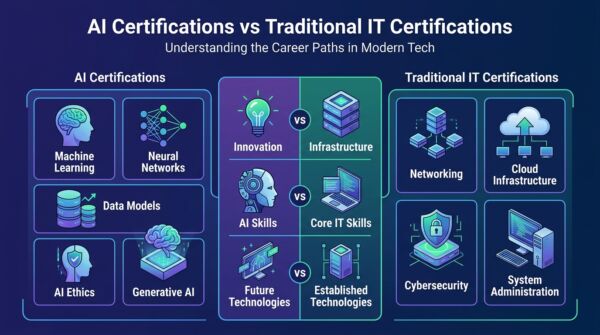
Entry-level AI certifications are designed to introduce foundational concepts related to artificial intelligence, machine learning, and data-driven technologies. These certifications typically focus on explaining how AI systems function, how models are trained, and how intelligent applications are deployed within digital environments.
Many introductory AI certifications are structured to support learners who may not have extensive programming or data science backgrounds. Instead of focusing heavily on mathematical modeling, they often emphasize understanding AI concepts such as supervised learning, natural language processing, and computer vision.
Candidates pursuing entry-level AI certifications are typically preparing for roles that involve working with AI systems, interpreting machine learning outputs, or supporting AI-driven projects. The certifications help establish baseline knowledge for careers related to data analysis, AI operations, or machine learning support roles.
Because AI technologies evolve rapidly, these certifications often highlight emerging trends, ethical considerations, and the societal impact of automated decision-making systems.
Understanding Traditional IT Certifications
Traditional IT certifications have been the foundation of professional development within the technology sector for many years. These certifications typically focus on core IT infrastructure skills such as networking, operating systems, cybersecurity, database management, and cloud computing.
Unlike AI certifications, traditional IT credentials emphasize the administration, maintenance, and security of digital systems. Examples include certifications related to network management, cloud platform administration, or security monitoring.
Professionals pursuing traditional IT certifications usually work in operational roles responsible for maintaining technology infrastructure. System administrators, network engineers, cloud engineers, and cybersecurity analysts often rely on these certifications to demonstrate their technical expertise.
These certifications typically require familiarity with specific technologies and tools used in enterprise environments. As a result, preparation often includes hands-on experimentation and configuration tasks.
Key Differences Between AI and Traditional IT Certifications
Although both certification types contribute to technical career development, their objectives and skill requirements differ significantly. The following table summarizes the primary differences between entry-level AI certifications and traditional IT certifications.
| Category | Entry-Level AI Certifications | Traditional IT Certifications |
|---|---|---|
| Focus | Artificial intelligence concepts and machine learning | Infrastructure, networking, security, and system management |
| Skill Orientation | Data interpretation and AI system understanding | Technical configuration and system administration |
| Technical Depth | Conceptual and analytical | Operational and infrastructure-focused |
| Tools and Technologies | AI platforms, data analysis tools | Networking tools, operating systems, cloud platforms |
| Career Direction | AI support roles, data analysis, AI operations | IT administration, networking, cybersecurity, cloud engineering |
This comparison illustrates how AI certifications emphasize emerging technologies and analytical understanding, while traditional IT certifications focus on maintaining and managing operational systems.
Skill Requirements and Learning Approaches
The learning approach for AI certifications differs from traditional IT certifications because of the nature of the technologies involved.
Entry-level AI certifications often require candidates to understand how algorithms process data and generate predictions. Concepts such as data quality, model training, bias detection, and AI ethics frequently appear in introductory certification programs.
Traditional IT certifications, by contrast, emphasize technical configuration skills. Candidates may be required to understand how to configure network devices, deploy cloud resources, manage identity systems, or monitor cybersecurity threats.
Because of these differences, study methods also vary. AI certification preparation may involve studying data workflows and algorithm behavior, whereas traditional IT certification preparation often includes lab-based practice involving system configuration and troubleshooting.
Professionals exploring technology certification paths often review structured preparation materials and practice questions available through CertEmpire.
Career Path Implications
Choosing between AI and traditional IT certifications can influence long-term career direction.
Entry-level AI certifications may serve as a starting point for careers related to artificial intelligence and data science. Individuals who pursue these certifications often continue their learning in areas such as machine learning engineering, data analysis, or AI model development.
Traditional IT certifications tend to lead toward operational technology roles. Professionals working in network administration, cloud infrastructure management, and cybersecurity frequently rely on these credentials to validate their skills.
In many organizations, both skill sets are becoming increasingly interconnected. Cloud platforms, for example, now host AI services that require administrators to understand both infrastructure management and AI deployment environments.
Exam Structure and Assessment Methods
Another difference between AI and traditional IT certifications lies in how exams evaluate candidate knowledge.
Entry-level AI certification exams typically focus on conceptual understanding and analytical reasoning. Questions may involve interpreting AI outputs, understanding model behavior, or identifying ethical considerations in AI implementation.
Traditional IT certification exams often include scenario-based questions related to system configuration, network troubleshooting, or cloud resource management. Candidates must demonstrate practical understanding of technology environments. Because of this operational focus, traditional IT exams frequently require deeper familiarity with technical tools and configuration processes.
Combining AI and IT Certifications
Rather than viewing AI and traditional IT certifications as mutually exclusive paths, many professionals pursue both. As AI technologies become integrated into enterprise platforms, organizations increasingly require professionals who understand both AI systems and IT infrastructure.
For example, deploying an AI-powered application in the cloud requires knowledge of machine learning models as well as cloud resource management and security policies.
Combining AI certifications with traditional IT credentials can therefore provide a broader skill set that supports emerging technology roles.
Candidates exploring certification preparation often review structured study resources and domain-aligned practice questions through platforms such as Cert Empire while building knowledge across multiple certification tracks.
Preparing for Certifications Effectively
Regardless of the certification path chosen, effective preparation typically includes several key components.
Candidates should begin by understanding the official exam objectives and identifying the domains that require the most attention. Study plans should then incorporate conceptual learning, practical experimentation where possible, and practice questions that simulate real exam scenarios.
Practice tests help candidates become familiar with the exam structure and highlight areas where further study is required. Reviewing incorrect answers and analyzing reasoning behind solutions improves conceptual understanding. Structured preparation ensures that candidates approach certification exams with confidence and clarity.
Bottom Line
Entry-level AI certifications and traditional IT certifications represent two important pathways within the technology industry. AI certifications introduce foundational knowledge of machine learning systems, data analysis, and artificial intelligence concepts. Traditional IT certifications focus on the administration and management of digital infrastructure, including networking, cloud platforms, and cybersecurity systems. While these paths differ in focus and technical requirements, they are increasingly interconnected as organizations integrate AI technologies into enterprise systems. Understanding the key differences between these certifications helps professionals choose a learning path that aligns with their career goals and technical interests.