
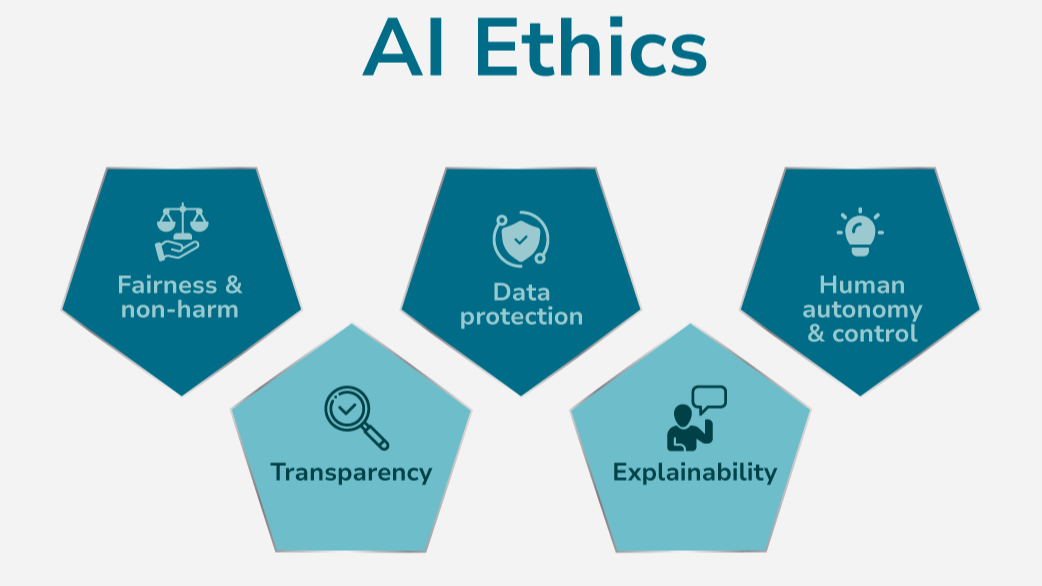
Today, companies prefer to incorporate AI systems that are not only smart but also responsible, transparent, and fair. And this is an important business consideration in 2026.
It is because this sensible choice allows leaders to avoid any system-oriented bias, while also ensuring accountability. Enabling fair treatment for all users, such AI systems can naturally align with the legal and ethical norms of the industry.
That being said, when AI is at the core of businesses today, their transparency, fairness, and responsibility are of paramount value. Mainly, this fundamental shift introduces a remodeled approach to developing AI systems that are free from bias and systematic discrepancies. And as the technical complexity of this task is higher, management requires consulting with seasoned AI solution providers to develop custom AI models that can cater to a company’s specific needs.
Ticking off bias, fairness, and explainability in this project deliverable while developing an AI model is important not only because it is merely an ethical concern.
-
In fact, it adds value by meeting compliance and legal norms of the firm. As a result, this lowers the risk of exposure to lawsuits and regulatory penalties.
-
This aspect also improves the audit readiness of the reports, thereby providing appropriate reasoning for how AI presents a decision.
-
Mainly, this explains why leaders trust in AI’s metrics and results, as it depicts responsible system behavior.
-
Finally, this change improves brand credibility among users and also boosts investor confidence.
Hence, it largely helps companies to build intelligent systems that can be trusted, regulated, and responsibly deployed at scale. With this perspective, this article aims to examine why bias, fairness, and explainability are an unmissable AI system component for modern companies today.
Understanding Bias, Fairness, and Explainability in AI Systems
As developing AI systems becomes the prime focus of the CTOs, an enterprise certainly must reflect on the AI model’s performance and expected deliverables. But they should also equally value how to make these systems reliable.
This is where studying the bias, fairness, and explainability matters. These concerns make AI systems more trustworthy and safe to be deployed in real-world environments.
With this perspective, let us understand these three key terms in detail moving ahead.
What is Bias?
From a technical standpoint, bias is considered a systematic error in AI output that puts some groups or patterns at an unfavourable disadvantage.
Generally, they arise due to errors in data collection, human bias involved in development, and predefined algorithm designs. They can also arise from historical data disparities.
That being said, its key characteristics are as follows:
-
Bias is systematic and repetitive, rather than just being a random error.
-
It causes discrimination towards some groups of individuals in most cases.
-
It can arise at any stage of AI engineering, from data collection to deployment.
Hence, it is necessary for technical teams to spot bias while designing data pipelines and validation frameworks, and rectify them before deployment.
What is Fairness?
In terms of deploying a safe AI system, fairness matters. Well, this term means doing right by users, groups, and different scenarios at all times.
Technically, fairness involves aspects such as:
-
Defining measurable fairness metrics like demographic parity, equal opportunity, and more.
-
This is followed by evaluating model performance across subgroups. This check avoids discrimination while ensuring overall accuracy.
-
Finally, fairness is balanced with precision and other metrics to ensure the correctness of the results.
Hence, fairness evaluation encompasses examining the ML pipeline, test environment, and model monitoring in real-time.
What is Explainability?
Explainable simply means justifiable. And in the AI content, this means that the model should be able to transparently share how it reached a decision (in a way that humans understand).
For users and leaders today, this has become even more important in the medical, finance, defense, and insurance sectors.
Technically, it involves the use of
-
Tools like SHAP (Shapley additive explanations), LIME (Local Interpretable Model-Agnostic Explanations), and more help in sharing complex predictions with detailed reasoning.
-
Decision trees and rule-based models also show clear decision paths (for better transparency).
-
Further, AI systems also maintain a record of how decisions are made for audit readiness.
Hence, engineering teams must plan to develop next-gen technology models with AI solution providers to ensure auditability, traceability, and explanativeness.
Overall, balancing these three elements together ensures that AI systems can be trusted, governed, and deployed responsibly without degrading business performance.
Why They are Called Next Engineering Challenges in AI Systems
Now, as leaders examine what these aspects mean, we come to an important question. And that is why these three are considered the next key engineering challenges in AI systems.
A simple answer to this concern is that AI development focuses on how an accurate model can be built, or how we ensure that AI systems make decisions responsibly.
For enterprises, these concerns convey important ethical challenges that AI engineering faces. And not taking care of these factors can introduce regulatory exposure, reputational risk, and operational uncertainty. This is why an AI system must have a governable decision infrastructure that upholds compliance, stakeholder trust, and user confidence.
In this context, bias, fairness, and explainability represent the next key challenges for this project. And building a system without these concerns in place is equivalent to compromising on its framework and performance in the long run.
How to Design Fair, Transparent, and Accountable AI Systems?
As leaders focus on designing fair and responsible AI systems by embedding fairness metrics, transparency, and accountability in the model’s architecture, the question arises: how can it be done correctly?
And from a financial viewpoint, this concern is of high value. If not planned effectively, this means that the company can waste its funds. Moreover, this implies that the model will need to be updated to ensure these are followed. So, that again adds to the costs of the project.
So, to avoid this mistake, consulting a DevOps consultancy can help. These professionals can accelerate and optimize the software development process based on your digital goals. Additionally, they follow a planned, agile approach that makes the project quite result-oriented and measurable as well.
With that viewpoint, this section analyzes the standard ways in which an AI model can be developed to ensure fairness, transparency, and accountability. For leaders, this knowledge is necessary as it will be their first step towards building the systems correctly. So, let us study the points below:
Essentially, responsible data engineering is used by teams to reduce the chance of biased, incomplete, or poorly documented historical data. This is because it affects model training and its results afterwards.
Mainly, it constitutes the following checks:
-
Checking whether the dataset reflects the real population and behavior diversity that the model will respond to in production.
-
Assessing if the data has any inequalities and biases
Apart from that, recording data sources is necessary as it ensures accountability, reproducibility, and assists in regulatory audits.
-
Fairness Evaluation
In an AI model development, fairness cannot be assumed. Instead, it needs to be measured using defined statistical and performance metrics.
First and foremost, this evaluation works on defining fairness metrics, which technically includes:
-
Demographic parity (are outcomes the same for different demographic groups?)
-
Equal opportunity (checking outcomes with respect to the same situations), and
-
Disparate impact (rate of discrepancy across groups).
This assessment helps teams review if the training data is balanced or if the results differ too much across groups. Further, if unfairness is represented in results, the models need to be retrained by reweighting underrepresented groups.
Hence, the simple idea is to identify bias and guide the system to act in a more balanced way. Moreover, it is important to ensure that the model does not consistently disadvantage certain people.
AI systems’ explainability simply implies that leaders should be able to understand why something happened. Mainly, this helps in model governance and documentation, which can explain the following:
-
What does the model do?
-
What data was it trained on?
-
Where does it work well?
-
Where it may fail?
-
What are its possible risks?
Moreover, involving certain controls in AI models is necessary, as it helps the decision-making to be transparent throughout the functions.
As a result, the goal of AI systems being explainable is that they remain accurate, controlled, and well-documented. Further, this also ensures accountability, so that changes can be requested to particular teams whenever needed.
Now, this aspect highly aligns with transparency. Basically, it means that if an AI system makes a decision, teams should be able to go back later and see exactly how and why it happened. This keeps the records auditable and traceable.
Here, the system keeps the record of every decision, such as:
-
What data was modeled?
-
What results were attained?
-
Which model version was used?
Moreover, the data is saved with an exact timestamp. So, this ensures that the records are made to be safe and trustworthy as well.
As a result, this enables teams to meet compliance and legal requirements at large. Overall, these practices make AI systems manageable, accountable, and legally defensible.
Final Thoughts
Wrapping up, we can say that bias, fairness, and explainability mark a turning point in how AI systems are engineered and governed by teams. So, apart from accuracy, accountability can be said to have an important impact on technology.
For organizations, this means that the systems need to be defined as controlled, auditable systems that operate within legal, ethical, and operational boundaries. Overall, measures like responsible data management, fairness evaluation study, and more focus on reducing regulatory risks.
Further, this helps improve system reliability while boosting stakeholder confidence and the long-term sustainability of AI initiatives. Hence, the future of AI lies in making it responsible and trustworthy by embedding biaslessness, fairness, and explainability in the systems altogether.
Author Bio:
Nitish Yadav is a technology-focused content exploring artificial intelligence, data systems, and the dynamics of responsible use of AI. With a strong understanding of AI engineering principles, he helps decision-makers understand how to build scalable, trustworthy, and future-ready AI systems that are transparent and fair in terms of operations and decision-making.