

Organizations today are surrounded by data. Every customer interaction, transaction, system log, and internal process generates information that is stored somewhere—often across multiple databases and platforms. Despite this abundance, many teams still struggle to extract meaningful insights when they need them most. The problem is no longer a lack of data, but a lack of accessibility.
Traditional data analysis workflows were built for specialists. Analysts write queries, dashboards are configured in advance, and reports are generated on fixed schedules. While these systems are powerful, they create friction for non-technical users who need answers quickly. As a result, decision-making is often slowed down by tooling rather than informed by data.
In recent years, conversational artificial intelligence has begun to change how humans interact with technology. From virtual assistants to AI-powered search, natural language interfaces are becoming the default. The same shift is now happening in analytics. AI database chatbots are emerging as a way to make data analysis simpler, faster, and more intuitive—transforming how organizations turn information into decisions.
The Growing Gap Between Data and Decisions
As businesses scale, so does the complexity of their data environments. Databases multiply, schemas evolve, and data becomes increasingly siloed across departments. While leadership expects teams to be data-driven, the tools available to most employees often tell a different story.
The gap between data and decision-making is created by several factors:
- Insights are locked behind technical skills such as SQL
- Analysts become bottlenecks for simple questions
- Dashboards answer predefined questions but limit exploration
- Reports are outdated by the time they are reviewed
For many teams, asking a new question means starting a new process. This discourages curiosity and leads to decisions being made on assumptions rather than evidence. When data access feels slow or intimidating, people stop engaging with it altogether.
AI database chatbots address this gap by changing how questions are asked and answered. Instead of navigating tools or writing queries, users interact with data conversationally—bringing insights closer to the point of action.
What Is an AI Database Chatbot?
An AI Database Chatbot is an intelligent conversational system designed to interact directly with structured data sources. It allows users to ask questions in natural language and receive accurate, real-time answers generated from live databases.
Unlike rule-based chatbots that follow scripted flows, database chatbots dynamically interpret user intent. They understand database schemas, relationships between tables, and business-specific terminology. When a question is asked, the chatbot translates it into a validated query, retrieves the relevant data, and presents the result in a human-readable format.
These systems go beyond basic reporting. They support follow-up questions, contextual exploration, and iterative analysis. Users can refine their queries naturally, just as they would in a conversation with a colleague, without needing to understand how the data is stored behind the scenes.
How AI Database Chatbots Work Without Exposing Complexity
Although AI database chatbots feel simple to use, they rely on a sophisticated technical foundation. Their goal is to hide complexity, not eliminate it.
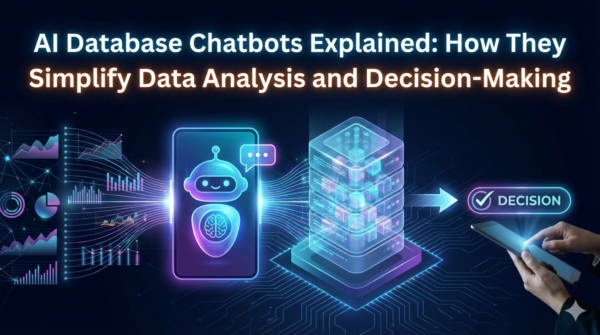
At a high level, the interaction flow looks like this:
- A user asks a question in plain language
- The chatbot analyzes intent and context
- The system maps the question to the database schema
- A secure and validated query is generated
- Data is retrieved and processed
- The chatbot summarizes and explains the result
Several layers work together to make this possible. Natural language processing helps the system understand phrasing and ambiguity. Schema awareness ensures the chatbot knows what data exists and how it is connected. Security and permission layers prevent unauthorized access, while response generation focuses on clarity rather than raw output.
The result is an experience where users interact with data naturally, without needing to think about queries, joins, or filters.
From Raw Data to Clear Answers
Most people do not think in tables or columns. They think in outcomes, comparisons, and trends. AI database chatbots are designed around this reality.
Instead of forcing users to translate business questions into technical logic, chatbots allow them to focus on what they actually want to know. Questions such as “Why did revenue dip last month?” or “Which products are underperforming this quarter?” can be explored conversationally, with the chatbot handling the mechanics.
This approach transforms data analysis into a dialogue rather than a task. Users can ask follow-up questions, request clarifications, or explore related metrics without restarting the process. Over time, this encourages deeper engagement with data and supports more informed decision-making across teams.
The Role of AI Model Training in Reliable Insights
While conversational interfaces make data more accessible, accuracy remains critical. Generic language models are not inherently equipped to understand complex databases or business-specific logic. Without proper tuning, they may misinterpret questions or generate unreliable results.
This is where AI model training becomes essential. Models must be trained and fine-tuned using database schemas, metadata, and domain-specific language. This training helps the chatbot understand how data is structured, how metrics are calculated, and what terminology means within a specific organization or industry.
Well-trained models are better at:
- Interpreting ambiguous or incomplete questions
- Understanding relationships between datasets
- Applying business rules consistently
- Reducing errors and misleading outputs
By grounding conversational AI in real data structures, trained models ensure that simplicity does not come at the cost of accuracy.
How AI Database Chatbots Simplify Data Analysis Across Teams
One of the most significant impacts of AI database chatbots is how they democratize access to data. Analysis is no longer limited to analysts or technical teams. Anyone with a question can engage with data directly.
This simplification delivers several benefits:
- Faster insights
Questions are answered instantly, without waiting for reports or dashboards. - Reduced dependency on specialists
Analysts can focus on complex work instead of routine requests. - Improved data literacy
Regular interaction with data builds confidence across teams. - More consistent decision-making
Everyone works from the same source of truth.
As a result, data becomes a shared resource rather than a gated asset.
Decision-Making in Real Time
Speed matters in modern organizations. Market conditions change quickly, customer behavior evolves, and operational issues require immediate attention. When insights arrive too late, opportunities are missed.
AI database chatbots support real-time decision-making by making data available at the moment it is needed. Teams can explore metrics during meetings, test assumptions on the fly, and adjust strategies without pausing for analysis.
This immediacy encourages a more iterative approach to decisions. Instead of relying on static reports, teams continuously refine their understanding as new questions arise.
Industry Applications of AI Database Chatbots
AI database chatbots are not limited to a single domain. Their ability to interact with structured data makes them adaptable across industries.
In healthcare, chatbots help administrators analyze operational metrics while respecting strict access controls. Insights that once required complex reporting can be retrieved conversationally.
In finance, they support transaction analysis, performance tracking, and compliance monitoring. Teams can explore trends without navigating complex tools.
E-commerce businesses use database chatbots to understand customer behavior, inventory performance, and sales patterns in real time.
Logistics and operations teams rely on conversational access to supply chain data, enabling faster responses to disruptions and inefficiencies.
Across enterprise and SaaS environments, AI database chatbots help product and revenue teams analyze usage data and business performance without relying solely on dashboards.
AI Database Chatbots vs Dashboards and BI Tools
Traditional business intelligence tools still play an important role in analytics. Dashboards are effective for monitoring known metrics and visualizing trends over time. However, they are inherently limited when it comes to exploration.
AI database chatbots complement BI tools rather than replacing them. While dashboards answer predefined questions, chatbots handle unexpected or evolving ones.
Key differences include:
- Dashboards are static; chatbots are conversational
- BI tools require training; chatbots rely on natural language
- Reports summarize data; chatbots explain it
Together, these tools create a more flexible and responsive analytics ecosystem.
Building AI Database Chatbots for Real-World Systems
Real-world data environments are rarely simple. Databases evolve, schemas change, and access controls vary by role. Off-the-shelf chatbot solutions often struggle to handle this complexity.
Effective implementations require custom integration, schema awareness, and validation logic. Development teams working in this niche design chatbots that align with real data usage and security requirements. For example, an agency like Triple Minds has worked across different industries to build AI database chatbots that adapt to varied data environments, demonstrating how these systems can be tailored beyond generic use cases.
Once deployed, a well-designed chatbot becomes a natural extension of the organization’s data infrastructure.
Product Prototyping and Early Validation with AI Database Chatbots
Beyond analytics, AI database chatbots are increasingly used during product prototyping and early-stage validation. Teams can use conversational data access to test assumptions, explore user behavior, and validate ideas before committing to full-scale development.
By integrating chatbots into early prototypes, teams gain immediate feedback from real data. This helps identify gaps, refine features, and align products more closely with user needs.
In this context, database chatbots act as both analytical tools and discovery mechanisms, supporting faster iteration and more informed product decisions.
Challenges and Limitations to Consider
Despite their advantages, AI database chatbots require careful implementation. Accuracy, security, and trust are critical when systems interact directly with business data.
Key considerations include:
- Role-based access and permissions
- Preventing incorrect or misleading responses
- Managing schema changes over time
- Encouraging adoption and proper usage
Addressing these challenges early ensures that chatbots remain reliable and valuable in the long term.
Real-World Scenarios
Consider a leadership team reviewing performance metrics during a strategy meeting. Instead of pausing to request a report, they ask follow-up questions and explore scenarios in real time.
A product team validates assumptions by querying usage data conversationally. An operations team identifies bottlenecks as they occur rather than after the fact.
These scenarios highlight how AI database chatbots change not just analytics workflows, but organizational behavior.
The Future of Conversational Data Analysis
As AI continues to evolve, conversational interfaces are likely to become the primary way people interact with data. Voice-based queries, multimodal inputs, and deeper system integrations will further reduce friction.
The future of analytics is not about replacing SQL, but about making it invisible. AI database chatbots allow organizations to benefit from powerful data infrastructure without exposing users to its complexity.
Conclusion: Making Better Decisions with Simpler Data Access
AI database chatbots represent a fundamental shift in how data is accessed and understood. By replacing technical barriers with conversation, they make data analysis faster, clearer, and more inclusive.
As organizations seek to become more agile and insight-driven, these systems play a crucial role in turning information into action. By simplifying analysis and supporting better decisions, AI database chatbots are redefining what it means to be truly data-driven.