
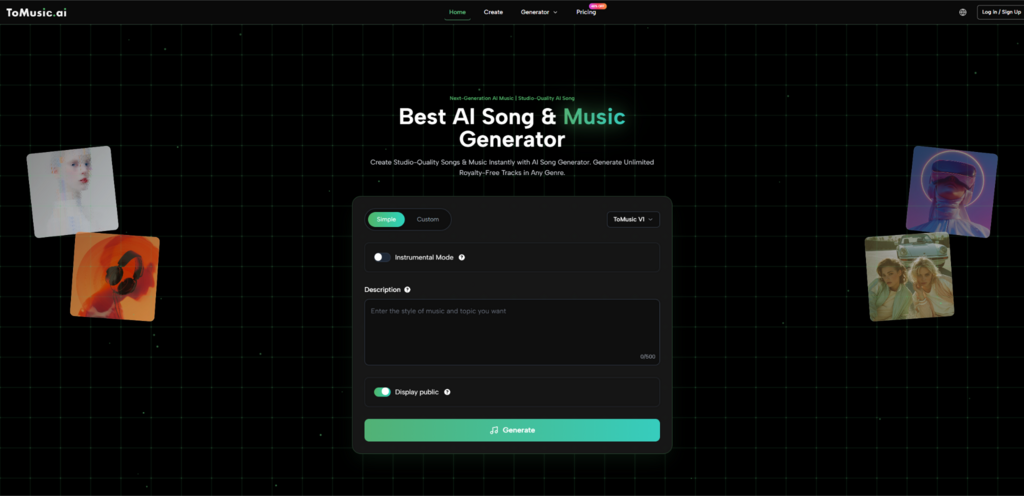
Most creators don’t struggle because they lack ideas—they struggle because the final 10% (sound, pacing, emotion) takes 90% of the time. I used to patch that gap with “good enough” stock tracks, but the moment a familiar melody showed up in someone else’s reel, my edit suddenly felt less like my own. That’s what pushed me to treat music like a creative layer I can prototype, not a treasure hunt I have to win. In my own tests, an AI Music Generator works best when you approach it as a rapid mood lab: you describe the intent, generate a few directions, and then refine until the soundtrack stops sounding like “background” and starts sounding like part of the story.
Why Stock Music Often Misses the Moment
The hidden mismatch
Stock libraries are optimized for broad usefulness. Your video is not broad—it’s specific. When your cut has micro-beats (a glance, a jump cut, a reveal), generic tracks can either overstate the emotion or leave it flat.
What I noticed in practice
In my workflow, the real time sink wasn’t downloading files—it was decision fatigue:
- Auditioning dozens of tracks that were “close, but not quite”
- Discovering the perfect chorus lift… that arrives 12 seconds too late
- Re-editing to fit a track, instead of finding a track that fits the edit
A calmer approach
The more reliable method is to start with intent and iterate with Text to Music. That means you don’t ask for “the perfect song.” You ask for three plausible drafts that are clearly different, then you choose what aligns with your story.
Think Like an Editor: Music Is a Cut, Not a Decoration
Before vs. after
When I treated music as a final step, it felt like polishing. When I treated it like an early creative decision, it started shaping structure:
- Intros became clearer (space for voiceover or room tone)
- Transitions became easier (swells where the visuals shift)
- Endings landed more naturally (resolution, not abrupt silence)
A useful metaphor
Music is like lighting in a film set. You don’t need the most expensive rig—you need the light to fall in the right place.
What to decide first (small but powerful)
- Emotion: calm, tense, playful, triumphant
- Texture: acoustic, cinematic, lo-fi, electronic
- Motion: drifting, steady, driving, bouncing
- Purpose: underline dialogue, carry montage, punch a reveal
One practical rule
If you can describe your scene in one sentence, you can usually get closer results faster than if you only name a genre.
Micro-tip
Write the prompt like a director’s note, not a marketing slogan.
A Two-Phase Workflow That Keeps You Out of the Rabbit Hole
Phase 1: Generate direction, not perfection
- Create three versions with intentionally different energy levels.
- Drop them into your timeline immediately.
- Pick the one that supports your pacing, even if it isn’t “amazing” yet.
Phase 2: Improve one variable at a time
This is where most people accidentally sabotage themselves—changing everything at once makes it impossible to tell what helped. Instead:
- Keep tempo, change instrumentation
- Keep mood, simplify arrangement
- Keep structure, increase dynamics
In one session, I found the best improvements came from small, disciplined edits to the prompt rather than constantly rewriting from scratch.
Where Prompting Actually Becomes Craft
There’s a difference between “asking for music” and “directing music.” When you treat generation like iteration, you naturally start thinking in constraints. In my experience, using Text to Music works best when you give the model a clear emotional job (“hold tension without feeling scary”) and a clear sonic palette (“soft synth pads, light percussion, minimal bass”), while Lyrics to Song is most useful when the words are meant to be performed (hooks, theme lines, chorus-first ideas) and you want to hear whether your syllables actually sing cleanly.
Comparison Table: What You Gain (and What You Give Up)
| Approach | Best For | Strengths | Trade-offs |
| AI-generated drafts (ToMusic-style) | Rapid mood matching, prototypes, multiple directions fast | Speed, variety, easier alignment with intent | Output varies with prompt quality; may need several generations |
| Stock libraries | Safe licensing, predictable structure | Consistency, familiar formats | Time spent searching; tracks can feel generic or overused |
| Hiring a composer | Signature sound, narrative precision | Human interpretation, bespoke scoring | Higher cost, longer timeline, revisions require coordination |
| DIY in a DAW | Full creative ownership | Deep control, long-term skill | Steep learning curve; slow for quick projects |
What Makes Prompts More Reliable
Use a three-part prompt
- Emotion: “quiet optimism with a hint of nostalgia”
- Palette: “piano + airy pads + soft brush percussion”
- Movement: “slow build, gentle lift, clear resolution”
Debug results like you debug edits
- Too busy? Ask for “more space” or “minimal arrangement”
- Too flat? Ask for “stronger dynamics” or “clearer build”
- Too random? Ask for “simple motif” or “repeating hook”
A surprising win
I’ve found that stating what you do NOT want (“no aggressive drums,” “no bright synth lead”) can be as helpful as stating what you want.
Limitations That Make This Feel Real (Not Like a Fairy Tale)
AI music can be excellent for exploration, but it’s not a one-click guarantee:
- Some generations nail the mood but miss structure.
- Two prompts that look similar can produce noticeably different results.
- If you rely on vocals, phrasing and pronunciation can vary and may take extra iterations.
- You may need multiple tries to get a clean intro that leaves room for dialogue.
The upside is that iteration is part of the point: you’re trading “searching forever” for “trying a few versions quickly.”
A Gentle Way to Use This Without Becoming Overly Dependent
If you’re building a brand or a consistent channel sound, don’t chase novelty every time. Instead:
- Save prompts that worked well and reuse the structure
- Maintain a small palette of moods that match your content style
- Generate variations within a consistent identity
That’s where the tool becomes less about replacing creativity and more about protecting it—keeping your momentum intact, so your ideas make it to the finish line with the emotion still alive.