🔹 SEO Summary
|
Element |
Details |
||
|
Primary Keyword (PKW) |
healthcare BI tools |
||
|
Meta Title |
Healthcare BI Tools in the USA | Trends, Use Cases & Top Platforms |
||
|
Meta Description |
Explore the top healthcare BI tools in the USA, key trends, and use cases driving better decisions, compliance, and operational efficiency in 2025. |
||
|
URL Slug |
/blog/healthcare-bi-tools-usa/ |
||
|
OG Title |
Healthcare BI Tools in the USA: Trends, Use Cases, and Top Platforms |
||
|
OG Description |
Learn how healthcare BI tools are transforming U.S. hospitals, payers, and health tech vendors with compliance-ready analytics and real-time insights. |
||
|
OG Image Alt Text |
Illustration showing BI dashboards and data visualizations used in U.S. healthcare organizations. |
||
|
SKWs |
healthcare business intelligence software,
|
Introduction
Across the United States, healthcare organizations are learning that data alone does not improve performance. Insight does. The challenge lies in turning massive volumes of clinical, operational, and financial data into decisions that enhance care quality and compliance. Business Intelligence (BI) tools have become the means to bridge this gap.
The U.S. healthcare BI market is expanding rapidly, projected to cross nine billion dollars by 2025. Hospitals, payers, and life sciences companies are investing in BI platforms that bring structure to complexity and transparency to decision-making. Yet the options are growing just as fast, leaving many leaders uncertain about which tools truly align with healthcare regulations, workflows, and long-term goals.
This guide explores the trends shaping BI adoption in the U.S. healthcare sector, real use cases across providers and payers, and a closer look at the platforms leading this transformation.
U.S. Market Landscape and Emerging Trends
Healthcare in the United States generates more data than any other industry, but its fragmentation across systems remains a major obstacle. The pressure to connect, analyze, and act on this data is increasing under regulatory frameworks such as HIPAA, HEDIS, and the Medicare Quality Payment Program. As a result, modern BI tools are evolving beyond reporting to become decision infrastructure for the entire enterprise.
Three clear trends define the U.S. BI landscape in 2025:
1. Self-Service and AI-Driven Analytics
Healthcare BI platforms are increasingly designed for clinicians and administrators who need insights without technical dependency. Natural language queries, AI-powered recommendations, and predictive analytics are now built directly into dashboards. This self-service approach accelerates decision-making while reducing the workload on data teams.
2. Real-Time and Cloud-Native Architectures
Health systems move from static reports to live dashboards. Real-time BI, powered by cloud-native architectures, supports operational visibility across emergency rooms, revenue cycles, and supply chains. U.S. hospitals use these systems to monitor occupancy, scheduling, and patient throughput in real time.
3. Compliance-First Design
The U.S. market demands BI tools that meet federal and state data privacy requirements. Vendors are emphasizing encryption, role-based access, and HIPAA-compliant hosting as default features. This compliance-first mindset is now a differentiator, especially for multi-state health networks managing diverse patient populations.
Together, these trends mark a shift from descriptive reporting to proactive intelligence that shapes how healthcare organizations function daily.
Top Use Cases of BI Tools in U.S. Healthcare
Modern BI systems have moved beyond spreadsheets and static dashboards. They now drive measurable impact across clinical outcomes, operations, and finance. The most common and high-value use cases in the U.S. market include population health, operational efficiency, revenue cycle performance, and compliance tracking.
Population Health and Risk Stratification
Providers across the U.S. are using BI tools to merge EHR, claims, and demographic data into unified patient views. These dashboards help identify high-risk populations, track preventive care compliance, and evaluate chronic disease management. When combined with predictive models, they support proactive outreach and reduce hospital readmissions.
Operational Efficiency and Resource Optimization
Hospitals rely on BI dashboards to monitor bed occupancy, staffing levels, and supply chain movement. Real-time visibility enables faster allocation of resources and reduction of delays in critical departments such as radiology or surgery. The insights from these dashboards support data-driven planning and cost containment.
Financial Analytics and Revenue Cycle Management
Revenue cycle leaders use BI tools to track claim denials, payment delays, and charge capture accuracy. Dashboards bring clarity to the entire billing process, allowing organizations to benchmark performance and identify revenue leakage. This has become essential for maintaining financial stability as reimbursement models evolve.
Quality and Compliance Reporting
Healthcare BI tools also play a vital role in maintaining regulatory readiness. U.S. hospitals must report on quality measures defined by HEDIS, CMS, and internal benchmarks. BI-driven compliance dashboards automate much of this process, reducing manual effort and minimizing the risk of reporting errors.
The combination of automation, transparency, and speed makes BI indispensable to modern healthcare management.
Criteria for Selecting Healthcare BI Tools in the U.S.
Selecting the right BI platform in healthcare involves more than comparing visualization features. Each organization must align the tool’s capabilities with its compliance obligations, data architecture, and user maturity. The following criteria define what healthcare decision-makers in the United States typically evaluate before purchase.
1. Compliance and Data Security
The foundation of any BI platform in healthcare is compliance with HIPAA and state-level privacy laws. Data encryption, role-based access control, and detailed audit logs must be built into the platform. Vendors that demonstrate strong security certifications and offer U.S.-based data centers are often preferred by hospitals and payer networks.
2. Seamless Data Integration
Healthcare BI tools should connect with EHRs, claims systems, lab interfaces, and patient portals through APIs or secure connectors. Native support for HL7 and FHIR standards simplifies integration and improves the accuracy of insights drawn from multiple systems.
3. Real-Time Processing and Scalability
With the rise of cloud-native BI, health systems expect near real-time updates and elastic scaling. This capability is vital for monitoring emergency departments, revenue cycle transactions, or supply levels where time-sensitive decisions affect patient safety and cost.
4. Self-Service and Usability
BI platforms must serve both analysts and non-technical users. Simple drag-and-drop interfaces, conversational queries, and guided templates allow clinicians, finance teams, and executives to explore data independently while maintaining governance controls.
5. Vendor Reliability and Support
Finally, a reliable support structure is essential. Vendors that provide localized support, implementation consulting, and continuous upgrades tend to have higher adoption rates in U.S. healthcare environments.
Top Healthcare BI Tools in the U.S. Market
The U.S. market offers a wide range of BI platforms, but only a few have matured enough to meet healthcare’s compliance, integration, and usability demands. The following tools have established strong adoption among hospitals, payers, and health technology vendors.
Power BI
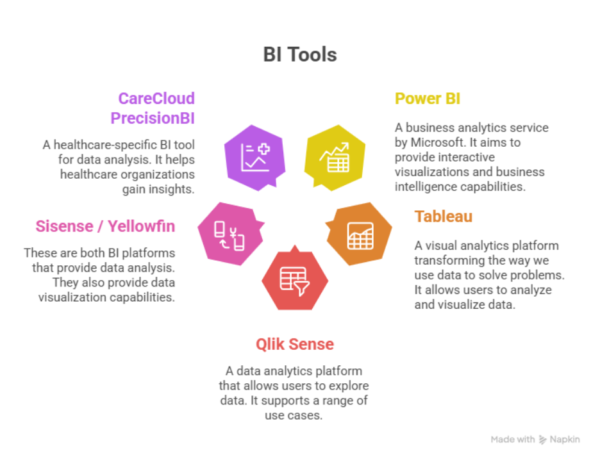
Microsoft’s Power BI has become one of the most widely adopted analytics platforms in U.S. healthcare. It integrates seamlessly with Dynamics 365, Azure, and most EHR systems. The platform offers strong data governance, customizable dashboards, and competitive pricing, making it suitable for both hospital networks and independent practices.
Tableau
Tableau remains a preferred choice for organizations focused on visual storytelling and exploratory analytics. Its ability to blend data from EHRs, wearables, and operational systems provides flexibility for diverse departments. The platform’s HIPAA compliance and strong visualization library make it popular for performance tracking and clinical outcome monitoring.
Qlik Sense
Qlik’s associative engine enables fast, in-memory analysis and self-service exploration. Healthcare organizations use it to visualize patient journeys, map claims data, and manage population health metrics. Its security model aligns well with U.S. compliance standards.
Sisense and Yellowfin
These tools cater to healthcare software vendors that embed analytics directly within EHR or RCM platforms. They support white-labeling, multi-tenant environments, and HIPAA-compliant deployment, making them suitable for HIT vendors seeking differentiation through built-in analytics.
CareCloud PrecisionBI
PrecisionBI, built for healthcare providers, offers preconfigured dashboards for billing, compliance, and clinical operations. Its U.S. presence, strong integration with RCM systems, and ready-to-use healthcare templates make it practical for small and mid-sized hospitals.
Together, these platforms represent the blend of flexibility, compliance, and scalability required by the U.S. healthcare system.
Implementation Best Practices
Implementing a BI platform in healthcare requires coordination across technology, governance, and adoption. Several lessons have emerged from successful U.S. deployments.
-
Begin with a clear data governance model that defines ownership and access.
-
Start small, with a pilot department, and expand based on measurable outcomes.
-
Align analytics objectives with organizational KPIs such as readmission reduction or revenue cycle accuracy.
-
Automate data refresh and quality checks early to prevent manual intervention.
-
Invest in user training and change management to drive long-term adoption.
When implemented systematically, BI tools can evolve from reporting utilities into intelligence engines that guide everyday operations.
Conclusion
The U.S. healthcare sector is entering an era where data-driven decision-making is no longer optional. Business Intelligence tools have become the link between raw data and meaningful outcomes, helping organizations improve clinical quality, reduce operational waste, and maintain compliance with evolving regulations.
The right platform depends on the organization’s size, systems, and regulatory exposure, but the objective remains constant: to make healthcare smarter, faster, and more accountable. For decision-makers seeking a foundation for this transformation, exploring reliable Healthcare BI Tools with the help of healthcare data analytics services is a practical place to begin.
OG: