


An increasing number of businesses are putting in efforts to hire prompt engineers capable of precise structuring of how large language models – LLMs respond in real life scenarios. These prompt engineers design text and refine high-quality AI training prompts custom-tailored to machine learning models. The growing demand of prompt engineers by itself speaks of how critical they have become for scaling effective AI systems.
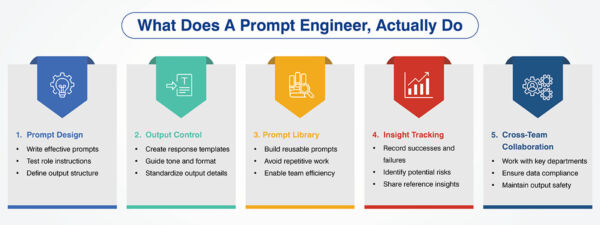
The tasks of a prompt engineer focus on the “tone” or “voice” of an artificial intelligence (AI) system. As a prompt engineer is not involved in coding, nor do they train models, they write language that the AI uses to produce a response based on the input that is given to the system.
When a project begins, the way a prompt engineer produces prompts for AI results usually follow an ad hoc method. It eventually needs to change to achieve consistency with the outputs produced by the AI. Furthermore, when a project scales, the amount of work required to clean up the outputs from the AI also increases, as well as the cost of the AI systems themselves.
By providing order via their prompts and defining the format of those prompts that result in the desired outcome, a prompt engineer tests the impact of slight variations in order to find the format to produce the best results. These variations are the biggest prompt engineering benefits in formatting, enabling the development of consistent processes by members of the team to reproduce the same process repeatedly.
The industry will be eager to implement this exact method of developing and testing, while continuing to evolve and improve.
Why are prompt engineers in-demand
Positions like Prompt Engineer (+135.8%) are among the fastest growing roles in 2025 reflecting on the rise in demand of an AI-native workforce that blends knowledge of technology with creativity and insight utilization.
With the new method of creating prompts based upon the proven standards for producing desired outcomes in LLM models, many industries will be relying on AI to produce desired results.
Since businesses have transitioned from experimental development to actual production usage of Large Language Models (LLMs), the job of prompt engineering has quickly become one of the most popular jobs in the AI space.
LLMs are currently used across customer service, analytics and internal automation. As a result, demand for professionals who can utilize LLMs to function reliably has increased exponentially as well.
Although media reports indicate high salaries and rapid hiring in various industries and geographies, the role of the prompt engineer has undergone significant changes over the past two years. The high-end salary of a prompt engineer in the U.S., for example, is impressive and is approximately $95,000+ for top talent!
Companies today place a great deal of value in professionals who know how to utilize AI’s raw capabilities to achieve a specific functional outcome. Is there any greater evidence of the value that these professionals bring to the table?
8 key benefits of hiring a prompt engineer

Prompt engineering offers multiple benefits for organizations that are keen to leverage the approach to deliver accurate answers to queries. Here are the top 8 benefits:
1. Improved accuracy and relevance of outputs from AI
The prompt engineer establishes what the AI model clearly understands to be “the question.” They generate more accurate and relevant outputs through the establishment of the appropriate context, directions and expectations for tone and structure.
Instead of getting general answers to your questions, you get the type of information that fits into the language of your business and meets the needs of your target market.
2. Time and cost savings
When the prompts are properly optimized, the development and implementation of a project will move at a much faster pace and will consume fewer resources. The prompt engineer eliminates the trial-and-error approach to finding the optimal solution, eliminates the need for manual cleanup of outputs, and limits the number of unnecessary model calls.
Therefore, waste is eliminated, and the team can concentrate on the strategic aspects of their work versus spending all of their time fixing problems.
3. Increased model customization and scalability
Prompt engineering allows organizations to change the behavior of an AI system without having to retrain the models themselves.
Hire a prompt engineer who can develop flexible prompt templates and modular workflows that can be duplicated across multiple departments and use cases. As the needs of the organization continue to grow, the system evolves without requiring it to be rebuilt from the ground up.
4. Alignment of AI output with organization’s business objectives and brand voice
AI systems should reflect the organization’s voice, not that of a machine. A prompt engineer will ensure that the output generated by the AI model will always reflect the organization’s voice, communication style and business priorities.
Whether it is customer support messages, marketing content, etc., the AI System will always represent the voice and mission of the organization.
5. More effective human-AI collaboration
Prompt engineers enable us to view LLM models as collaborative partners.
By defining clarity as to how these models respond, the context they use, and when to hand off decision-making authority back to humans, Prompt engineers enable teams to collaborate with these models effectively.
This increases levels of trust, transparency, and confidence in the decisions made by the AI System.
6. Ethically responsible use of AI
Properly constructed prompts will avoid dangerous outputs, misdirection and bias. Prompt engineers are cognizant of the ethical implications associated with AI and construct their prompts with careful consideration so as to encourage accuracy, fairness and compliance. It is not just about the results; it is about utilizing AI ethically.
7. Competitive advantage through innovation
Early investment in prompt engineering enables organizations to create innovative and efficient ways to utilize AI. These organizations experiment, learn and improve at a much faster rate than those who are still experimenting with the trial-and-error method.
When an organization employs a prompt engineer, they are creating a culture of intentional and systematic innovation vs. unintentional innovation.
8. Continual optimization and testing
The performance of LLM models is fluid and continues to fluctuate. Prompt engineers continually test and evaluate the performance of these models and create feedback mechanisms to conduct small-scale tests.
They seek to identify which method works best and continually develop the AI models to produce better results.
How to know when your business needs a prompt engineer
A prompt engineer can create better and more aligned-to-goals AI projects by substituting guesswork with rules-based decision-making.
In Customer Service
The prompt engineer can develop prompts that allow a company’s chatbot to clearly communicate answers that meet the brand voice while only escalating necessary issues to human agents.
Additionally, the consistency developed using these prompts enables customers to trust the interaction they have with the service provider and reduces the burden on human agents.
In insurance and banking
The prompt engineer can
- develop prompts to ensure sensitive information is handled properly;
- summarize documents accurately; and
- flag uncertain AI-generated responses for review, which provides both protection and accountability to automated solutions.
In marketing operations
The prompt engineer can assist teams in developing on-brand content, testing different messaging options, and ensuring the tone is consistent across multiple communication channels.
Irrespective of the specific area of operations, the true value in hiring a prompt engineer is the level of control and ability to measure: structured context (i.e., using tables) to “keep the model grounded” and ongoing evaluations to demonstrate what is working and what is not working, so improvements can be made.
What skills and screening criteria are required to hire a prompt engineer
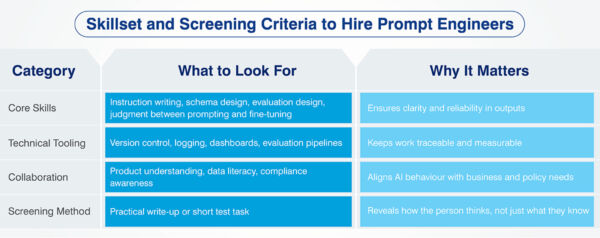
When hiring, it helps to go beyond a simple interview. Ask for a short write-up that shows how they’d frame a problem, create prompt variants, define an evaluation plan, and estimate token costs. How they think through that process will tell you far more than their résumé.
Here is the screening criteria:
Conclusion
Prompt engineering has quietly become the underlying structure upon which effective AI results are delivered. Rather than following basic and popular trends, it is about establishing rules-based decision making; providing structure, clarity and accountability to how teams use LLMs and creating purpose with AI systems, keeping the context, results and impact aligned with business objectives. For businesses, this means faster delivery times, lower costs and fewer surprises.
For HabileData, the teams stick to a discipline and a standard that ensures that their work is aligned with business projects and remains consistent. Every prompt should be a part of a reusable process: versioned, measured, and aligned to business goals.
As AI continues to become a part of everyday operational activities, the value of having someone who can speak both human and machine languages will continue to grow. A prompt engineer ensures that what the AI produces is intelligent, useful, safe, and reliable enough to be used widely across operations.