
AI application development is no longer optional—it’s fast becoming the backbone of how today’s leading enterprises transform their operations, products, and services. In an environment where fast operations, making data-informed decisions, and being adaptable are the characteristics of success, the companies that use AI application development services are making a path to gaining a competitive edge.
We will take a look at how AI applications are being used by enterprises in the areas of digital transformation that are considered most critical.
Strategic Alignment: Beginning with the Right Business Objectives
Enterprises, before writing even one line of code, always ensure that the use of AI is in accordance with the company’s strategic goals. They consider matters like: What is the business problem we are addressing? To what extent will an AI solution drive growth, and efficiency, or inspire innovation? Moreover, how will it mesh with our current systems and culture?
When defining outcomes clearly for custom AI app development—be it cost reduction, new product line introduction or customer experience enhancement—companies are not going to be trapped into creating technology only for its sake. It is common for organizations to set up a multidisciplinary team comprising business analysts, data scientists, and IT architects to keep AI applications business-centric.
Data & Model Readiness: The Engine of Intelligent Applications
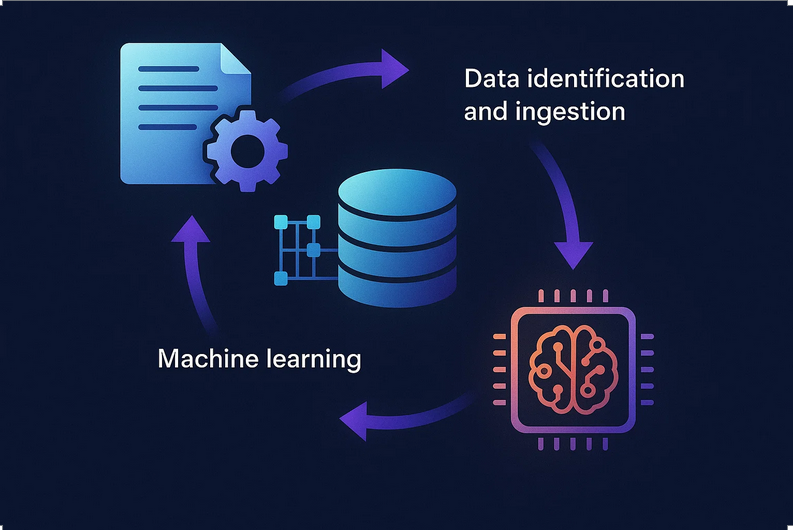
After the objectives have been set, the next step for the companies is to get ready the data and the models that will drive the AI applications. This step consists of:
- Data identification and ingestion coming from various sources (ERPs, CRMs, IoT sensors, logs)
- Data infrastructure building (data lakes, warehouses, lakehouses) for storing, processing, and accessing data
- Machine learning, deep learning, or NLP models development or refinement using proprietary data
If the AI application lacks this foundation, its development becomes guesswork. When companies implement the AI-driven software solutions that are based on relevant and high-quality data, the outcomes are more trustworthy: they include better predictions, smarter automation, and more human-like interactions with users.
Automating and Augmenting Workflows
One huge, noticeable change is the way companies adopt AI tools for workflow transformation by replacing humans for the functions they perform repetitively and sometimes the sharing of human work. AI is carrying out human actions in different areas like document management, customer interaction through chatbots, predictive analysis, and supply chain movement.
An illustration of such a practice is:
- The interaction with customers takes place through virtual assistants powered by AI technology that replies, connects with human agents, and improves its skills based on past experiences.
- AI is in the axios of applications that are making the equipment ‘s life better by detecting problems, and facilitating maintenance.
- AI is there in logistics by making predictions of what the customers will want, controlling the stock according to this, and managing the shipment in the best way.
However, the point is not only that the AI applications are added features but they are involved in and even the driving force behind the technological development of enterprises. This results in a lion’s share of the allocated resources, in form of human workers, becoming available for high-value tasks due to the large gains in efficiency.
Personalization and Enhanced Customer Experience
More and more, businesses are taking advantage of AI application development for the purpose of offering extremely personalized experiences to individual users. The applications learn and change during the interaction based on the analysis of user behaviour, preferences, and historical data.
This comes about in several ways:
- Content, products or services are suggested through recommendation systems that are specifically designed for the user according to their past activity.
- AI insights make it possible to have dynamic pricing and targeted marketing.
- Conversational artificial intelligence that directs users through difficult processes or sales
When AI is successfully applied, companies experience an increase in customer interaction, a decrease in customer loss, and an increase in customer loyalty — factors that are often accompanied by the support of software product engineering specialists to provide scalable deployment.
Innovation & New Business Models
Beyond improving existing processes, leading enterprises use AI application development to leap into new business models. They create products or services that wouldn’t have been possible without AI: smart assistants, predictive-as-a-service platforms, adaptive learning systems, or AI-powered diagnostics in healthcare.
In doing so, they turn AI applications into strategic assets — not just cost-savers, but differentiators that open new revenue streams and market segments. Many of these innovations stem from AI-enabled web applications that seamlessly blend analytics, automation, and user experience.
Governance, Ethics & Scalability
The implementation of AI applications on a large scale in an organization brings with it a set of difficulties. Companies have to figure out the questions of governance (who is the owner of the models?), the question of ethics (is there any bias?), the question of security (is the data safe?), and the question of sustainability (what is the carbon cost?). In addition, they have to consider scalability—what will be the performance of the AI applications in case the usage is multiplied ten times or even a hundred times?
Companies that are successful in the use of AI embed AI governance from the very beginning, and thus model transparency in decision-making, monitor for bias, and design for modularity and reuse. They are also looking to integrate the DevOps automation for AI projects into their broader IT and business architecture so that the growth is controlled and the value is continuous. Moreover, by applying IT staff augmentation services, organizations can increase team’ size in an efficient manner as AI initiatives develop.
Final Thoughts
Digital transformation with purpose is the proper way of applying AI application development as it is the strong part of the lever. The top enterprises do not simply adopt AI—they amalgamate it with their strategy, processes, data, products, and culture. They develop enterprise AI solutions that provide operational efficiency as well as business innovation.
The winners in the organizations are those that consider AI application development as a constant project and not as a one-time project. They will incorporate the core capability into their mindset, operation, and growth.