
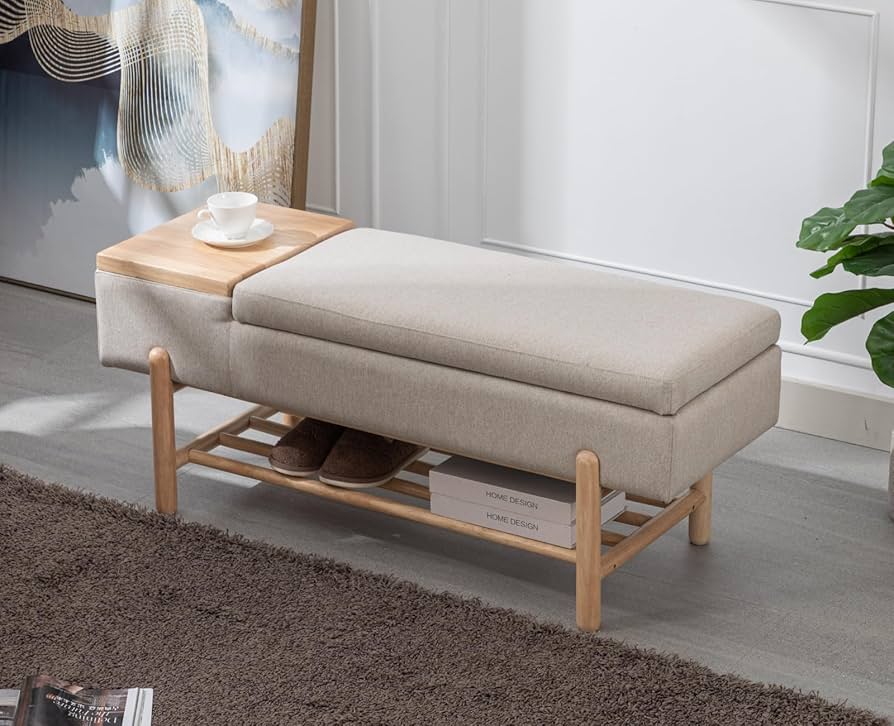
In a world increasingly dominated by smart devices, even the humble furniture piece is getting an intelligent upgrade. In this article we explore how a traditional wooden storage bench evolves via the Internet of Things (IoT) and artificial intelligence (AI) into a smart space-optimisation tool — and what that means for homes, designers, manufacturers and data-driven decision makers.
1. The Starting Point: Wood, Function & Storage
The storage bench has always had a clear purpose: a place to sit and a place to store. For example, consider a bench from this collection of shoes storage benches — ideal for combining seating and storage for footwear. Such pieces are familiar, reliable, and built from time-tested materials like wood.
However, despite their utility, traditional benches face limitations:
- You can’t see what’s inside without opening it.
- Usage patterns (how often items are stored/retrieved) remain invisible.
- The bench is a passive object in the home.
- Space is static: the bench is designed once and remains unchanged.
In other words: great for storage, but limited in adaptability, insight and efficiency.
2. The Shift: Smart Furniture, IoT & Data
What’s “smart” about a storage bench?
By embedding sensors, connectivity, and analytics into what would otherwise be a simple wooden bench, we turn it into a “smart storage bench”. Examples from the broader smart-furniture domain show how benches are being equipped with environmental sensors, communication modules and even charging stations.
Imagine: the bench monitors how often its lid is opened, how long items stay inside, the weight of contents, maybe even the ambient humidity or temperature inside the storage compartment. This data then streams into a cloud or edge analytics system, enabling insights and automated actions.
Why data matters
- Usage analytics: How many times per day do you access the storage? What times? Are some items never accessed?
- Space optimisation: If you know retrieval frequency, you might re-organise items accordingly (frequent items up front).
- Maintenance & durability: If sensors detect high weight loads or high humidity inside the compartment, alerts can trigger to prevent damage.
- Design feedback: Manufacturers collect aggregated, anonymised usage data to design future benches that better fit real-world behaviour.
In fact, the global smart furniture market is forecast to grow significantly: the stools & benches segment is projected to be one of the faster-growing categories.
3. How It Works: IoT + AI in a Smart Storage Bench
a) Hardware layer
- Sensors (e.g., accelerometer when lid opens/closes; weight sensor inside; RFID or optical for item detection).
- Connectivity module (WiFi, Bluetooth, Zigbee) to transmit data.
- Edge microcontroller to pre-process data (e.g., filter out noise).
- Optional indicators (LEDs, mobile app alerts) for user feedback.
b) Data layer
- Data streams in (lid open events, contents weight, timestamp, humidity etc).
- Stored in a time-series database (for IoT scenarios, something like Apache IoTDB may be used for massive ingestion of sensor data).
- Data cleaning, aggregation and feature engineering (e.g., frequency of access per day, unused items over 30 days, weight trend).
c) Analytics / AI layer
- Clustering or classification to segment items: e.g., “rarely accessed”, “frequently accessed”.
- Predictive modelling: “This compartment will exceed safe load in next 30 days”, or “User likely to need retrieval between 5-7 pm”.
- Interface/dashboard for user: mobile app or web portal showing “You haven’t accessed 12 items in the last 60 days — consider relocating”.
Research shows IoT-driven smart furniture systems can achieve strong performance in usability, adaptability and user satisfaction via machine-learning clustering methods.
d) Action
- The bench can prompt the user: “Items X have been unused; relocate them to secondary storage”.
- The bench can signal maintenance: “Humidity inside storage box is high; please ventilate”.
- Over time, design makers use the collected data across units to improve future versions (better materials, improved compartment size, etc.).
4. Use-Case: Smart Bench for Shoe Storage
Let’s illustrate with a scenario involving a bench from the Shoes Storage Bench collection.
- You purchase a wooden bench with built-in sensors. It monitors when you lift the lid, counts the number of shoes placed inside, measures weight, and logs time of day.
- After three months, the mobile app shows:
- You access the bench once in the morning (7-9 am) and again in late evening (8-10 pm) most days.
- 20 % of shoes inside haven’t been retrieved in 45 days.
- Weight increase trend is stable until you added boots in January, after which capacity is nearly full.
- The system suggests: “Consider relocating seldom-used boots to a high-shelf; put everyday shoes up front” and “Capacity is approaching limit; monitor further additions”.
- Designer/manufacturer gets aggregated anonymised usage data from many users: sees that users seldom access after 10 pm, items heavier than 3 kg reduce retrieval frequency, and lids opened more than 5000 times in lifetime show hinge wear. They use that data to design a next-gen bench with reinforced hinges, modular compartments and a lid-open sensor alert for maintenance.
The result: a bench that is more than furniture — it’s a data-informed storage optimisation hub.
5. Why It Matters: Insights for Stakeholders
For homeowners
- Achieve better organisation and space utilisation: smart benches help you make decisions based on real usage, not guesswork.
- Maintenance alerts can extend furniture life.
- Integration with smart home ecosystem: the bench can become part of the connected home (e.g., notify you when humidity high inside storage).
For designers & manufacturers
- Real-world usage data enables data-driven design — instead of relying solely on prototypes or assumptions, you use actual user behaviour. Industry articles note how furniture firms are using big-data and analytics to spot emerging design trends.
- Smart benches can open new product tiers (premium models with sensor & analytics).
- Helps with sustainability: by tracking usage and material loads you can plan for longer lifecycles, material reuse, and digital product passports.
For the data & tech community
- Furniture becomes a new node in the IoT fabric — each piece can supply meaningful sensor data for optimisation.
- Bench data contributes to time-series databases, analytics pipelines, and possibly edge computing models.
- Opportunity to explore privacy, security and data ethics: for example, item retrieval data may reveal routine behaviour (when you come home, what shoes you wear etc) — raising questions about data-governance in smart furniture.
6. Challenges & Considerations
- Cost vs value: Smart furniture has higher cost. Some users may not perceive enough added value. The smart furniture market faces such barriers.
- Data privacy & security: Sensor and retrieval data may be personal. Clear policies and user consent matter.
- Durability & maintenance: Electronics integrated into furniture must be reliable over many years.
- Interoperability: Standards and compatibility (smart home platforms) matter for seamless experience.
- Design constraints: Embedding sensors should not compromise aesthetics, ergonomics or material quality.
7. What’s Next: The Future of Smart Storage Benches
- Modular upgrades: Add-on sensor kits for existing benches.
- Predictive layout: Bench might suggest reorganising items based on seasons (e.g., winter boots vs summer sandals).
- AI-driven personalisation: Use machine learning to learn your habits (e.g., you wear sandals on weekends) and optimise storage accordingly.
- Sustainability tracking: Bench communicates its lifecycle, materials used, and end-of-life reuse possibilities (digital product passport).
- Integration with home analytics: Part of a larger data ecosystem (smart wardrobe, connected home, space-usage analytics).
- Data-driven manufacturing feedback loop: Real-time aggregated data influences future bench designs (size, compartments, sensors embedded) — exactly the kind of “big data thinking in furniture design” that recent research highlights.
8. Conclusion
From the simple wooden bench to the sensor-infused smart storage system — the journey from wood to data shows how furniture is evolving. A piece like a bench may appear passive, but when augmented with IoT and AI it becomes active: collecting data, offering optimisation, feeding design insights.
In a world where space is becoming scarce, usages are changing, and smart homes are becoming the norm — furniture needs to evolve too. By embracing IoT and AI, storage benches are no longer just places to sit and stash—they are intelligent partners in how we live, store and move.