
The future of artificial intelligence is not just about smarter models or larger datasets. It is about the invisible infrastructure that makes AI possible, the computing backbone that powers machine learning pipelines, enables real-time analytics, and ensures resilience in an unpredictable world.
Behind every successful AI-driven enterprise lies a cloud strategy that defines how data flows, how models train, and how insights scale. Yet, as AI workloads grow more complex and mission-critical, enterprise leaders are revisiting an essential question: Should we adopt a multi-cloud approach or a hybrid cloud strategy?
Understanding the Difference
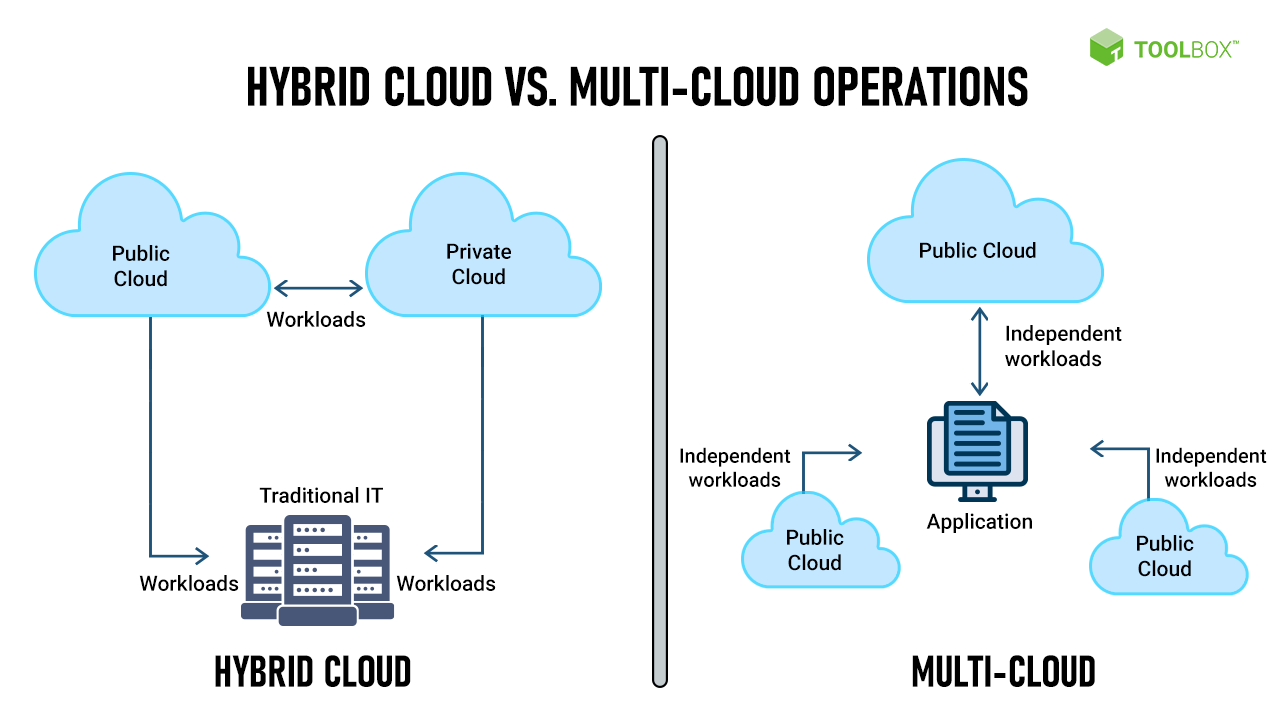
A hybrid cloud is a mix of private and public cloud environments. It connects on-premises data centers or private infrastructure with one or more public clouds. The strength of a hybrid setup lies in integration. Businesses can keep sensitive data, legacy applications, or high-security workloads in their private environment while using public clouds for agility, scalability, and innovation.
In contrast, a multi-cloud strategy uses multiple public cloud providers such as AWS, Azure, and Google Cloud, often for different workloads. A company might run AI model training on Google Cloud for TensorFlow optimization, use AWS for data warehousing, and leverage Azure for seamless enterprise integration. The goal is not always integration between these clouds but diversification and strategic freedom, avoiding dependency on a single vendor while using the best services from each ecosystem.
Both strategies sound appealing, but when AI becomes the centerpiece of your business, the implications of each approach differ dramatically.
The AI Imperative
AI workloads are unlike traditional computing. They require massive computational horsepower, high-throughput data access, GPU acceleration, and the ability to scale elastically. They also demand stringent compliance, data sovereignty, and real-time responsiveness.
Choosing between hybrid and multi-cloud is therefore not a technical preference; it is a strategic decision that defines how your organization manages innovation, risk, and competitive agility.
A hybrid cloud environment offers greater control and security. Industries like banking, healthcare, and government often prefer it because it allows sensitive data to remain within private infrastructure while leveraging the cloud for scalable compute power. For organizations handling personally identifiable information (PII), health records, or financial transactions, this balance is critical.
On the other hand, multi-cloud environments are the playgrounds of innovation. Each public cloud brings unique AI and ML capabilities such as Google Cloud’s advanced data analytics, AWS’s unmatched scalability, and Azure’s enterprise-grade integrations. By mixing and matching, enterprises can accelerate AI development cycles, reduce costs, and prevent vendor lock-in.
Why This Debate Matters for AI Transformation
AI is no longer confined to experimental labs. It now drives core business outcomes, from predictive supply chains to conversational AI agents and personalized banking experiences. But none of this intelligence works in isolation. The cloud architecture underneath determines model performance, latency, compliance, and ultimately, ROI.
Here’s how to determine which model aligns better with your organization’s AI goals.
When a Hybrid Cloud Strategy Makes Sense
A hybrid model excels when:
-
Data residency and compliance are non-negotiable. Regulated industries need to keep specific data within national borders or within private data centers.
-
Legacy systems are deeply embedded. Some workloads cannot be easily migrated to the public cloud due to integration complexity or cost.
-
Incremental modernization is the goal. A hybrid model lets enterprises modernize without disruption, keeping core systems intact while building new AI capabilities in the cloud.
-
Security is paramount. Sensitive data can remain behind the firewall while public clouds handle non-critical processing.
Hybrid strategies create a bridge between innovation and compliance. They enable organizations to explore AI possibilities without compromising data integrity or control.
When a Multi-Cloud Strategy Is the Better Fit
A multi-cloud setup is ideal when:
-
The goal is innovation at scale. You can leverage the best AI services from different providers, such as Google’s AI APIs for NLP, AWS SageMaker for large-scale training, and Azure Synapse for analytics.
-
Vendor lock-in is a concern. Multi-cloud gives you freedom to switch or balance workloads as pricing, performance, or regulations evolve.
-
Global scalability is critical. AI models can be deployed closer to users by leveraging multiple regional data centers from different providers.
-
Your workloads are cloud-native. Multi-cloud is easiest when data and applications are already designed for portability and API-based orchestration.
Multi-cloud strategies encourage agility. They allow organizations to experiment faster, adopt new tools, and respond to technology shifts without being constrained by one provider’s ecosystem.
How AI Changes the Equation
In traditional IT environments, cloud decisions were mostly driven by cost and uptime. AI introduces new dimensions such as data movement, model training speed, GPU availability, and latency.
For instance, an AI-driven retail company may need to train recommendation models daily based on new data. If training happens on a public cloud but the data resides in a private one, latency can slow the entire pipeline. Similarly, when deploying models to the edge for real-time fraud detection or predictive maintenance, the proximity of compute and data becomes essential.
In a hybrid setup, these data transfers can create friction. The system may face delays during model retraining or inference. Multi-cloud, by contrast, allows teams to pick the most optimal infrastructure for each stage of the AI lifecycle. But it introduces new challenges in governance, cost control, and interoperability.
This is where AI orchestration and interoperability tools come into play. Platforms like Kubernetes, Ray, MLflow, and data fabric architectures can unify disparate cloud environments. They allow models, data, and workloads to move seamlessly between providers, ensuring performance without sacrificing compliance.
Balancing Control, Innovation, and Cost
The most mature AI enterprises are not choosing between hybrid or multi-cloud; they are blending the two. For example, a global bank might use a private cloud for secure transaction data while using Google Cloud for AI-based fraud analytics. Similarly, a manufacturing firm could use AWS for predictive maintenance models while hosting sensitive IoT data on its private infrastructure.
The balance lies in aligning AI use cases with the right environment:
-
Model training and experimentation thrive in public clouds due to scalability.
-
Inference and operational deployment may reside in hybrid or private environments for lower latency and higher control.
-
Data governance and lineage demand consistent policies across all clouds.
Enterprises must also build cloud-agnostic architectures that allow AI applications to adapt as needs evolve. Adopting standards-based APIs, containerized workloads, and infrastructure-as-code (IaC) practices makes it easier to shift or replicate AI services across environments.
The Future Outlook
As AI evolves, so will cloud strategies. The future is unlikely to be strictly hybrid or purely multi-cloud. Instead, it will be a fusion of both, a composable architecture where workloads dynamically move based on performance, cost, or compliance needs.
We are already seeing this hybrid-multi model emerge in sectors like retail, logistics, and manufacturing, where AI models run on the cloud but make real-time decisions at the edge. Edge computing, in particular, adds another layer of complexity and opportunity by bringing inference closer to users and devices.
This next wave of AI infrastructure will depend heavily on interoperability, data fabrics, and intelligent automation. The winners will be enterprises that treat cloud not as a static platform but as a strategic enabler of intelligence across every business function.
CIOs and CTOs should begin by:
-
Mapping AI use cases to specific infrastructure capabilities.
-
Evaluating cloud providers for their AI toolsets, compliance, and integration ecosystems.
-
Building cloud-agnostic data pipelines to ensure flexibility.
-
Investing in observability and cost governance tools to manage multi-cloud complexity.
-
Creating a unified AI governance framework to maintain transparency and accountability across clouds.
Final Thoughts
The future of AI will not belong to a single cloud provider or a single strategy. It will thrive across interconnected ecosystems, each optimized for a specific aspect of intelligence, performance, or security.
Whether you choose a hybrid cloud for control or a multi-cloud strategy for innovation, the real objective remains constant: to enable AI to operate wherever it delivers the most value. Enterprises that build flexible, interoperable, and well-governed cloud architectures will lead the AI era with resilience and confidence.
In the coming years, the question will no longer be which cloud you use but how intelligently you use it.