
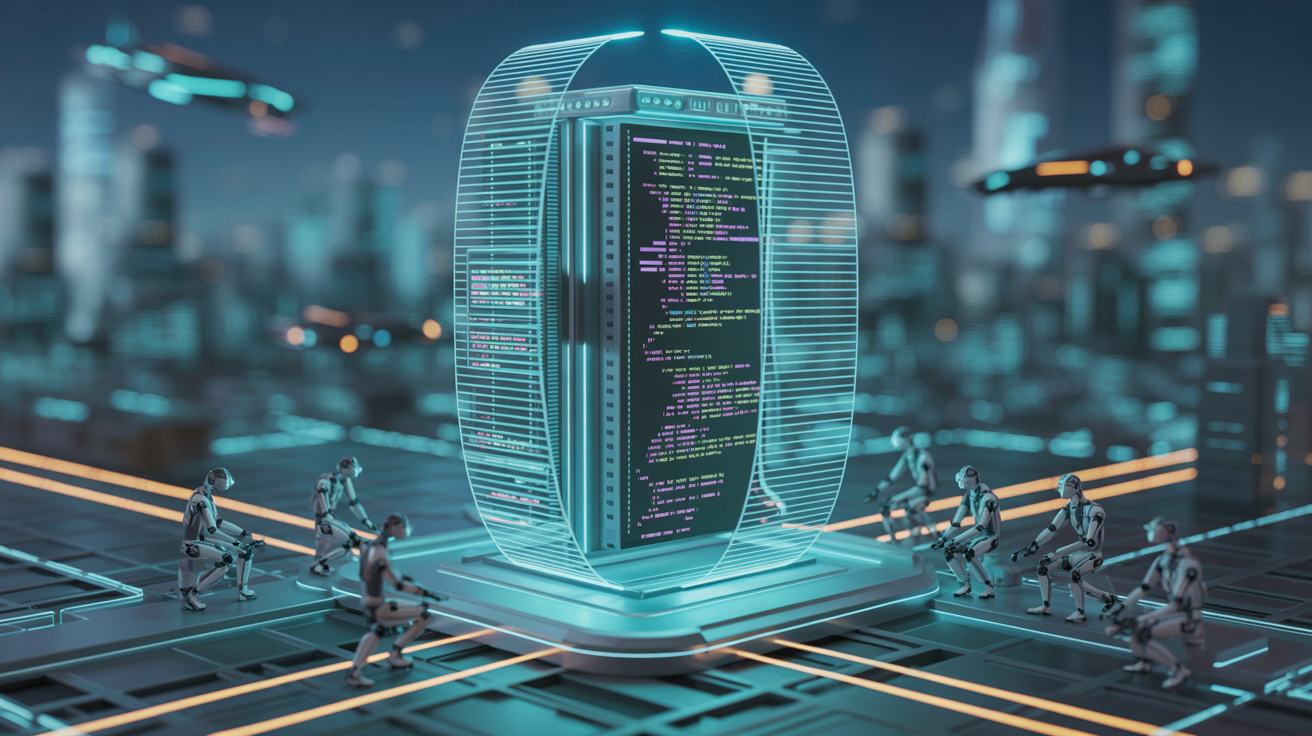
The world of software development is currently undergoing a significant transformation, with artificial intelligence at its core. The domain of human artistry, encompassing simplicity, is now being intensely prepared, enhanced, and automated by AI, including the design, coding, testing, and deployment of software. But the question is, how will AI impact software development? What new frontiers will it unlock?
This blog examines the evolving role of AI throughout the software development lifecycle. We’ll analyze the far-reaching impact of AI on software development, which is shaping how we develop tomorrow’s technologies. Get ready to discover how AI is becoming the ultimate copilot, driving unprecedented efficiency, quality, and innovation.
Role of AI in Software Development
The impact of AI on software development is widespread, affecting every stage of the software development lifecycle. Let’s break down how AI is bringing revolution in each stage:
1. Requirements and Plan: Smart Foresight
Gone are the days of collecting manual requirements. Now, AI has stepped in:
- Analyze user data: AI can identify patterns, predict user needs, and inform facility priorities by sifting through large amounts of user feedback, market trends, and historical data. This data-powered approach leads to more market-led products.
- User stories and acceptance criteria: AI tools can assist in drafting precise user stories and acceptance criteria from high-level requirements, ensuring clarity and stability from the outset.
- Risk prediction and resource allocation: By analyzing past project data, AI can accurately estimate potential risks and hurdles and determine resource requirements, thereby enhancing project planning and execution.
2. Design and Architecture: Smart Blueprint
AI is strengthening developers to create stronger and more efficient designs:
- Automatic wireframing and prototyping: AI-driven design tools can generate functional prototypes from an initial wireframe, mockup, and even text details, significantly reducing design time.
- Optimal architecture suggestions: AI can analyze the project’s requirements and suggest an optimal system architecture, database schema, and component structures based on best practices and scalability principles. This helps to avoid the design flaws early.
3. Coding and Implementation: Generic Leap
This is the place where the effect of AI is most clear and at the forefront:
- Intelligent code generation: GitHub Copilot, Tabnine, and Google Gemini Code Assist tools can suggest complete tasks and translate natural language details into programming languages. This accelerates the coding process, especially for boilerplates and repeated functions.
- Code modernization and translation: AI can help revamp legacy codebases, suggest improvements for clarity and maintenance, and even translate code between different programming languages.
- Error prevention: By analyzing the code reference, AI can identify coding mistakes and suggest improvements, leading to cleaner, more readable, and error-free code.
4. Testing and Quality Assurance: AI Sentinel
AI is transforming testing from a reactive process into an active guardian of quality:
- Automated test case generation: AI can automatically generate extensive test cases by analyzing requirements, user stories, or existing code, ensuring comprehensive testing and identifying edge cases.
- Intelligent bug detection and prediction: AI-powered tools excel at scanning the codebase for micro bugs, security weaknesses, and performance issues. They can predict the areas of the code most likely to incorporate defects, allowing developers to focus their testing efforts where they are most needed.
- Self-healing test: Advanced AI business solutions can also adapt the test script to accommodate changes in UI or underlying code, thereby reducing the maintenance burden of automated tests.
5. DevOps and Deployment: The Seamless Flow
AI CI/CD is weaving itself into pipelines, making the deployment smooth and more reliable:
- Intelligent monitoring and anomaly detection: AI systems continuously monitor the application’s performance and infrastructure health, detecting anomalies and predicting potential outages before impacting users.
- Automatic deployment and rollbacks: AI can automate complex deployment tasks, manage infrastructure, and even automate rollbacks. If the issues are detected post-deployment, AI ensures high reliability and rapid recovery.
- Resource adaptation: AI analyzes resource usage patterns to suggest optimal scaling strategies, improve efficiency, and reduce cloud infrastructure costs.
6. Maintenance and Operation: Active Care
After deployment, AI plays an important role:
- Future-stage maintenance: AI analyzes performance metrics and logs to identify potential bottlenecks and suggests targeted reforms to ensure smooth operation.
- Automatic event management: AI-operated chatbots and virtual assistants can handle regular user queries, generate self-service documentation, and even help related teams address complex issues, improving support efficiency.
The Evolving Role of Software Developers
The rise of AI does not mean the end of software developers’ roles. It marks the evolution of the role. Developers are no longer code writers; They are becoming:
- AI curator and reviewer: Developers thoroughly review and refine the AI-generated code, ensuring its accuracy, efficiency, safety, and alignment with project goals and ethical principles.
- Problem solutions and innovation: Free from mundane, repetitive coding, developers can dedicate more energy to complex architectural challenges, design novel solutions, and push the boundaries of software capabilities.
- AI architects and engineers: A new demand is emerging for professionals who can design, implement, and manage AI systems within the development pipeline, encompassing prompt engineering and AI ethics.
- Strategic thinkers: Developers will focus more on “why” and “what to build” to make strategic decisions about product functionality, user experience, and overall business impact.
- Cross-disciplinary collaboration: AI tools promote better cooperation by providing frequent coding patterns and bridging the communication gap between technical and non-technical stakeholders.
The integration of AI in software development presents an unprecedented opportunity. By embracing AI as a copilot, we can accelerate innovation, enhance software quality, and empower developers to focus on their creative and impactful work.
Future of AI in Software Development
AI increases human abilities significantly. Here is a look at some significant trends:
Personalized AI Assistant (True AI Copilot):
- Beyond basic tips: Current AI coding assistants are just the beginning. Future AI tools will come to understand individual developers’ coding styles, project references, and even their preferred problem-solving approaches.
- Active problem solution: AI will constantly identify possible issues, suggest complex architectural changes, and even generate a complete, convenient implementation based on oral or written requirements.
- Relevant logic: The next wave of generative AI will focus on enhancing logic and reasoning, enabling AI to dynamically understand references, consider inherent details, and apply the same logical stages as humans.
Agent for Autonomous Development AI:
- Self-managing workflows: Agentic AI systems will emerge, capable of breaking down growth challenges into manageable stages, multiple tests, and learning from replication with minimal human intervention.
- Automated SDLC phase: There will be more autonomous agents handling specific SDLC stages, from drafting user stories to generating deployment scripts to monitoring and responding to production incidents.
- Full-stack generation: AI’s autonomous natural language description is getting closer to reality, where AI can manage everything from UI/UX design to backend logic and database setup.
Explainable AI (XAI):
- Transparency in decision-making: As AI integrates, the demand for Explainable AI (XAI) will increase. Developers and stakeholders will need to understand why AI created a code suggestion, bug prediction, or design option. It is essential for debugging, auditing, and building trust, especially in regulated industries.
- Ethical AI by design: A strong focus will be placed on developing AI systems for software development that are inherently fair, transparent, and unbiased in their operation.
Supercharged By a Low-Code/No-Code Platform AI:
- Freedom of development: AI will make software development even more accessible to non-technical users. Low-code/no-code platforms, which are already gaining traction, will be enhanced with AI. They’ll allow business analysts, product managers, and even domain experts to automate workflows and create designs with minimal or traditional coding.
- AI-driven adaptation: AI will suggest relevant modules, optimize the UI based on user behavior, and translate natural language into the functional application logic within these platforms.
AI-Driven Observation and AIOPS:
- Predictive operation: AI will move beyond simple monitoring to Predictive Operations (AIOP). This system will estimate failures, identify performance obstacles before they affect users, and even provide automatic remedial suggestions or implementation.
- Intelligent root cause analysis: AI will quickly indicate the root cause of complex issues in the production environment by analyzing data metrics and tracking information.
- Self-healing applications: Future applications will be more self-aware and self-healing. Utilizing AI to repair issues automatically will minimize downtime and eliminate the need for human intervention.
Edge AI and TinyML for Local Intelligence:
- Decentralized processing: Edge AI will increase the tendency to process data, especially for IoT, autonomous vehicles, and real-time applications in industrial automation. The AI model will be adapted to resource-based tools, enabling intelligent decisions to be made on the edge without continuous cloud connectivity.
- Privacy and benefits: Edge AI offers benefits by minimizing delays through the localization of sensitive data and enhancing data privacy.
Special Small Language Model (SLM):
- Cost and efficiency: While large LLMs are powerful, the future will likely see an increase in the adoption of small language models (SLMs). These SLMs are cost-effective, require less infrastructure, and offer better performance for particular tasks.
- Domain-specific accuracy: Trained on curated high-quality domain-specific data, SLMs can provide more accurate and relevant outputs for software development.
The future of AI in software development holds promise for a collective partnership between human simplicity and artificial intelligence. Companies and developers who embrace these trends and customize their skill sets will be at the forefront of this exciting new era.
In a Nutshell
The future of AI in software development is no distant vision but a rapidly unfolding reality. It again defines how we develop and interact with technology. We are moving beyond AI from merely being a tool towards an era where it acts as a wise copilot.
By partnering with a professional AI coding tools expert like Aegis Softtech, we can responsibly and strategically embrace AI, unlocking a new era. Here, software is not only rapidly created but also naturally more intelligent, adaptive, and capable of solving complex problems in ways we imagine. The revolution of AI in software development is here, and it is an exciting journey for all of us.