
Artificial intelligence (AI) has become a game-changer in almost every industry. From healthcare to finance, businesses are integrating AI to improve decision-making, automate tasks, and boost efficiency. However, not every company can rely on pre-trained AI models because they don’t always fit unique business needs. That’s where custom AI model training comes into play. By training models specifically for a company’s data, organizations can achieve higher accuracy, domain relevance, and long-term scalability.
What is Custom AI Model Training?
Custom AI model training means building or fine-tuning a machine learning model based on specific datasets and objectives. Unlike generic solutions, a custom-trained model is designed to handle unique challenges faced by an organization.
For example:
-
A retail AI model for product recommendations trained on purchase behavior.
-
A custom healthcare AI model that analyzes medical images to detect rare diseases.
-
A machine learning fraud detection system trained on financial transaction data.
This personalization ensures the AI system is more reliable, accurate, and business-focused.
Why Businesses Need Custom AI Models
Using only pre-trained solutions may save time, but they often lack the domain-specific accuracy that industries demand. Here’s why organizations are shifting to custom AI development:
-
Precision – Tailored AI improves decision-making accuracy.
-
Data Security – Models are trained on in-house data, protecting sensitive information.
-
Scalability – Custom models grow with business demands.
-
Competitive Edge – A unique solution sets you apart in crowded markets.
-
Better ROI – Optimized results reduce costs and maximize returns.
Steps in Custom AI Model Training
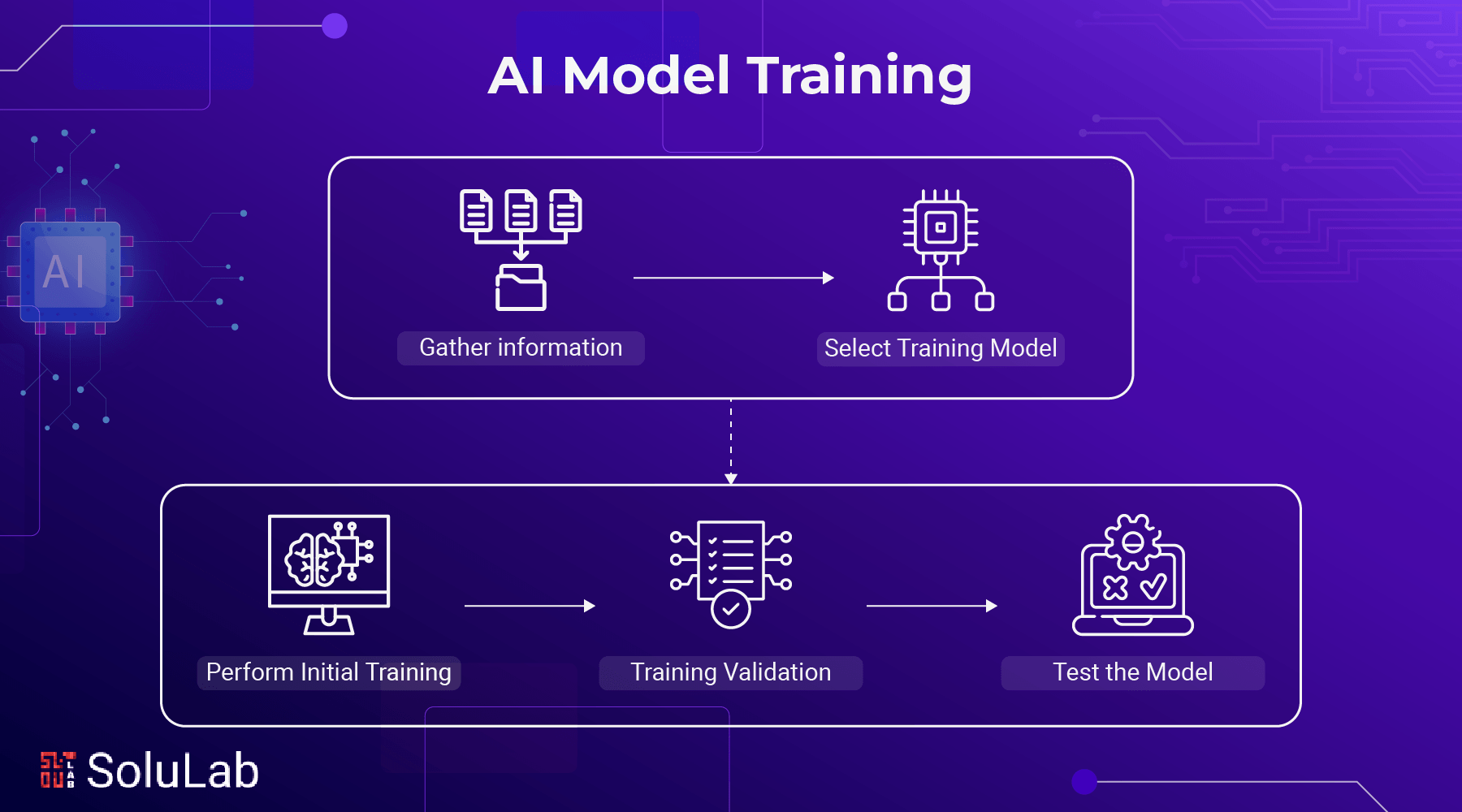
Building an AI system requires a structured approach:
-
Data Collection & Preparation – Gathering, cleaning, and labeling data.
-
Model Selection – Picking the right algorithm (CNNs, RNNs, transformers, etc.).
-
Feature Engineering – Identifying crucial input variables.
-
Training & Validation – Testing model accuracy on real-world datasets.
-
Hyperparameter Tuning – Adjusting variables for performance improvements.
-
Deployment – Integrating the model into business workflows.
-
Monitoring – Regular updates to ensure relevance and accuracy.
Benefits of Custom AI Model Training
-
Improved accuracy with domain-specific AI
-
Cost reduction via automation and smarter workflows
-
Flexibility in deployment (cloud, edge, hybrid systems)
-
Enhanced customer experience with personalization
-
Scalable AI models designed for long-term growth
Challenges in Custom AI Model Development
While powerful, custom AI models do come with challenges:
-
High computing requirements for training.
-
Dependence on skilled data scientists.
-
Risk of biased outcomes if training data isn’t diverse.
-
Ongoing updates required to adapt to new patterns.
Use Cases of Custom AI Model Training
-
Healthcare – Custom-trained AI models for disease prediction and medical image analysis.
-
Finance – Machine learning fraud detection models and credit risk scoring.
-
Retail & E-commerce – Personalized product recommendation engines.
-
Manufacturing – Predictive maintenance AI for minimizing downtime.
-
Logistics – Demand forecasting and route optimization.
Conclusion
Custom AI model training empowers businesses to move beyond one-size-fits-all AI and embrace domain-specific machine learning solutions. By combining short-tail keywords (like AI training and machine learning models) with long-tail keywords (like custom AI model training for healthcare and AI model development for finance), companies not only reach wider audiences but also attract high-intent users.
In the long run, businesses that invest in custom AI solutions gain more accuracy, security, and scalability than those relying solely on pre-trained systems.