
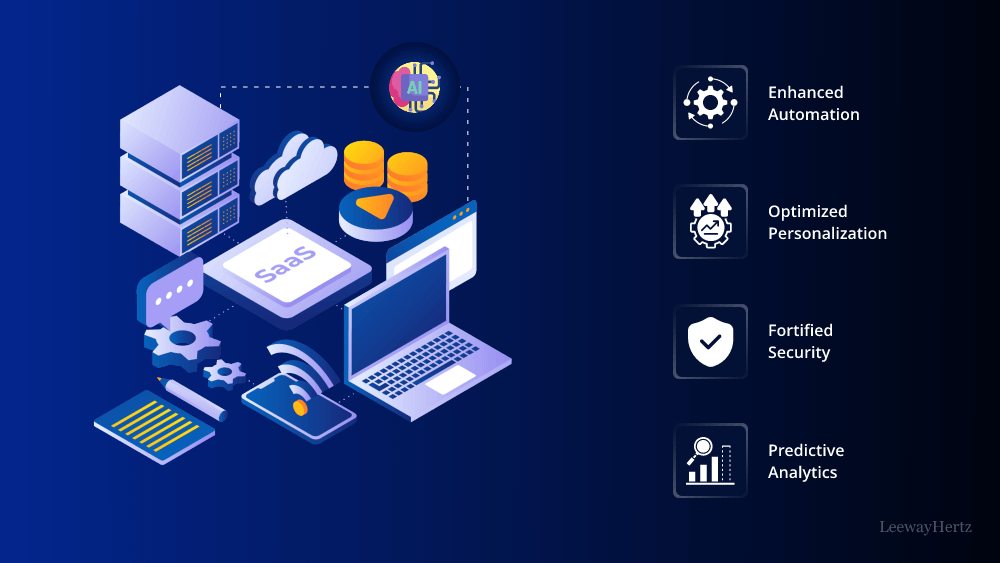
In the rapidly evolving Software-as-a-Service (SaaS) landscape, one truth stands out: the companies that will thrive are the ones that harness the power of AI in SaaS. SaaS has always been about agility, scalability, and speed. But as the market becomes more crowded and customer expectations climb higher, AI is no longer a “nice to have.” It is now the engine that powers customer success, streamlines operations, and unlocks entirely new possibilities in product innovation.
This is not about theoretical promises or futuristic visions. AI in SaaS products is already reshaping businesses in tangible ways. Companies that integrate AI agents into their customer success strategies are seeing churn rates drop and Net Promoter Scores rise. Teams that leverage AI in product design and development are outpacing competitors with smarter, faster, and more personalized features. And leadership teams that view AI as a growth driver rather than just a cost-saving tool are building SaaS products that remain relevant in an era of constant disruption.
Let’s take a closer look at how AI is transforming SaaS in two of its most critical dimensions: customer success and product innovation.
AI as the Cornerstone of Customer Success
Customer success is the beating heart of any SaaS company. Unlike traditional software, SaaS thrives on long-term relationships and recurring revenue. If customers do not achieve their desired outcomes, they leave. AI in SaaS offers an unprecedented ability to predict customer needs, personalize interactions, and automate support at scale.
1. Predictive Customer Health Scoring
Traditional customer health scoring relies on backward-looking metrics such as login frequency or support tickets raised. AI in SaaS products flips this model by analyzing historical usage patterns, product adoption, sentiment from customer interactions, and even external market signals to forecast churn risk. Instead of reacting when it is too late, customer success teams can proactively step in to re-engage customers.
For example, an AI model can flag that a mid-market client whose product usage dipped by 15% after a new feature rollout is at high risk of disengagement. Armed with this insight, the CSM can schedule a targeted training session, ensuring the customer derives value before they even consider canceling.
2. Hyper-Personalized Customer Journeys
AI allows SaaS companies to move beyond generic onboarding and engagement sequences. By clustering customers based on behavior, industry, and goals, AI can tailor content, product tutorials, and communication. This ensures each customer feels like the platform was built for them.
Imagine a SaaS project management tool that automatically adapts its onboarding for a marketing agency versus a software development team. Instead of overwhelming users with irrelevant workflows, AI in SaaS delivers only what they need to succeed. The result is faster adoption and deeper product stickiness.
3. Intelligent Support at Scale
Chatbots and virtual assistants powered by AI are no longer basic FAQ responders. They now handle complex support queries, escalate issues intelligently, and even predict potential technical glitches before they surface. This reduces support costs while improving the customer experience.
More importantly, AI can analyze thousands of support conversations to detect recurring pain points. If 20% of users repeatedly ask about a specific feature, product managers can act on this insight to simplify design or update documentation.
AI as a Catalyst for Product Innovation
Customer success ensures retention, but true differentiation in SaaS lies in product innovation. Here, AI is not just an enabler; it is a creator of entirely new possibilities. From data-driven feature prioritization to generative design, AI in SaaS products is accelerating how companies innovate.
1. Data-Driven Roadmap Decisions
SaaS companies collect a goldmine of data, but the challenge is making sense of it. AI can synthesize usage patterns, feedback sentiment, and competitor insights to guide product roadmaps. Instead of relying solely on intuition, product leaders can make evidence-backed decisions.
For instance, if AI reveals that 60% of enterprise customers consistently use a workaround to achieve a task, this signals an opportunity for a native feature. The data not only justifies the investment but also quantifies the potential revenue impact of building it.
2. AI-Powered Feature Development
Generative AI models are already being used to prototype features, design user flows, and even write code snippets. This accelerates development cycles and reduces time-to-market. A SaaS product that once required six months of development for a new feature can now deliver it in weeks.
Beyond speed, AI also enhances creativity. Tools like generative design can suggest multiple variations of a feature, allowing teams to explore options that human designers might not have considered. This leads to more intuitive and user-friendly products.
3. Continuous Product Optimization
Innovation is not a one-time event but a continuous process. AI enables real-time monitoring of how features are used, which versions perform better, and where friction arises. This allows product teams to iterate faster and optimize products on the fly.
Consider a SaaS collaboration platform that tests two variations of a task assignment feature. AI can analyze adoption, completion rates, and even user sentiment in real-time to determine which version drives better outcomes. Instead of months of A/B testing, decisions can be made within days.
Real-World SaaS Companies Leading with AI
The power of AI in SaaS is not theoretical. Many industry leaders have already embedded AI into their customer success and product innovation strategies:
-
Salesforce integrates AI through its Einstein platform, giving customers predictive lead scoring, automated insights, and smarter sales recommendations.
-
Zendesk leverages AI for automated support and customer intent prediction, reducing ticket resolution time dramatically.
-
HubSpot uses AI for content personalization and sales forecasting, helping businesses increase conversion rates while reducing manual effort.
These examples demonstrate that AI is not reserved for tech giants. Startups and mid-sized SaaS companies are adopting AI in SaaS products to scale faster and differentiate themselves.
Overcoming Challenges of AI in SaaS
While the benefits are undeniable, implementing AI in SaaS comes with challenges. Data privacy regulations, integration complexities, and the risk of over-automation need to be carefully managed. Companies must strike a balance between leveraging AI for efficiency and preserving the human element in customer relationships.
The key is to build AI systems that augment human teams rather than replace them. A customer success manager armed with AI-driven insights is far more effective than one buried in spreadsheets. A product team guided by AI analytics can focus on creative problem-solving instead of data crunching.
Taking Action: How SaaS Leaders Can Get Started
If you are building or scaling a SaaS business, the question is not whether to adopt AI but how to do it strategically. Here are actionable steps to begin:
-
Start with Customer Success: Identify where churn is highest and deploy AI-driven health scoring or support automation to make quick wins.
-
Leverage Existing Tools: You don’t need to build AI from scratch. Platforms like AWS, Azure, and Google Cloud offer ready-to-integrate AI services tailored for SaaS.
-
Prioritize Data Readiness: AI is only as powerful as the data behind it. Invest in data collection, cleaning, and governance to maximize ROI.
-
Pilot AI in Product Innovation: Use AI to validate roadmap decisions or test feature prototypes. Scale gradually as confidence builds.
-
Keep the Human Touch: Always combine AI’s efficiency with human empathy to create a customer experience that feels both intelligent and personal.
The Future of AI in SaaS
We are still in the early innings of AI in SaaS products. The future points to autonomous SaaS platforms that anticipate customer needs, self-optimize features, and even evolve business models in real-time. The companies that invest in AI today will be the ones shaping this future.
For SaaS leaders, the call to action is clear. AI in SaaS is no longer a distant vision. It is here, and it is redefining what it means to deliver value. Whether through smarter customer success or breakthrough product innovation, AI is the difference between being disrupted and being the disruptor.
Final Thoughts
The SaaS industry has always been defined by speed and innovation. Now, AI is rewriting the rules of competition. By embedding AI in SaaS products into customer success and product development, companies can move from reactive problem-solving to proactive value creation.
The opportunity is immense, but it requires action. The question every SaaS leader should ask is. How can I use AI today to serve customers better and innovate faster?
Those who answer boldly will not only survive but lead the next era of SaaS.