
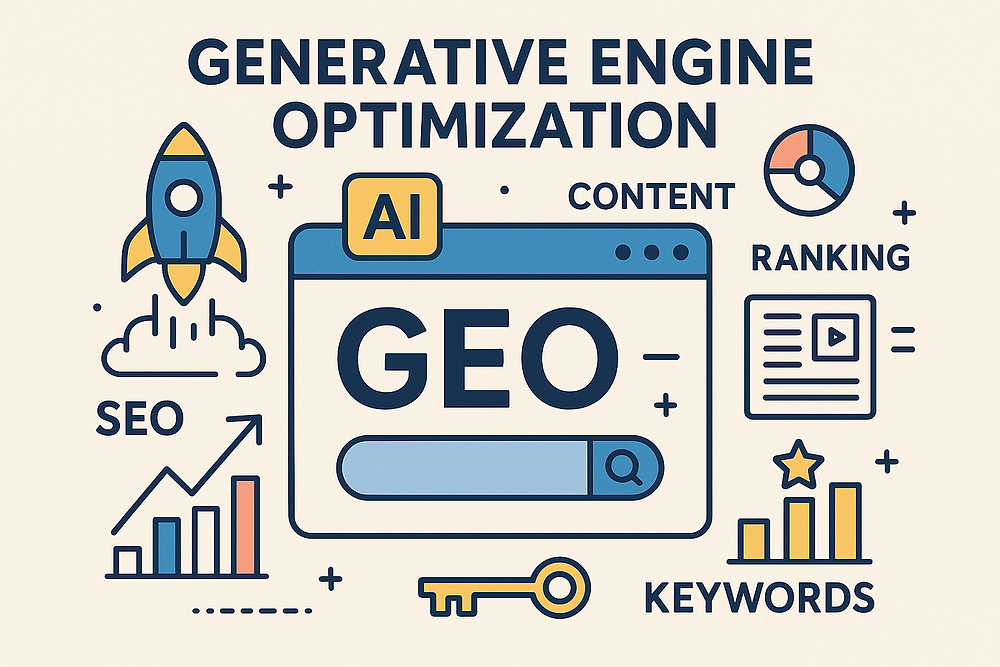
If you’re running a business in Houston and working with or are part of an SEO company in Houston, you might have heard the term “Generative Engine Optimization” (GEO) tossed around lately. It’s not just another buzzword. GEO is rapidly changing how content is discovered and rewarded in search-like experiences driven by AI. Understanding it now can put you ahead—not chasing trends, but adapting smartly as search evolves.
In this guide, we’ll explain what GEO is, why it’s important, how it works, and how your Houston-based business or agency can apply it. We’ll also cover common challenges and practical steps so you can start leveraging GEO for more visibility, more trust, and more growth.
What Is Generative Engine Optimization (GEO)?
Generative Engine Optimization, or GEO, refers to optimizing your digital content so that AI-driven systems (like ChatGPT, Google’s generative features, Perplexity, etc.) not only find your content but are also likely to use it when generating responses.
Here are some of its distinguishing features:
-
Instead of just focusing on traditional ranking (keywords, backlinks), GEO emphasizes content clarity, factual correctness, structure, and trust.
-
It’s about being part of the answer, not just being part of a list of links. AI tools often generate conversational responses, summarizing content or quoting high-authority sources.
-
It includes the use of structured data (schema), FAQ sections, authoritative sources, consistency in information (like contact details and credentials), and semantic content alignment (covering intent, contexts, and related topics).
According to recent research, GEO can significantly improve visibility in AI-generated search responses when done right. me for Businesses
For an SEO company in Houston, GEO is a strategic shift. Here’s why it matters now:
-
Search behavior is evolving: more people are asking full questions and expecting direct responses from AI tools. They are less interested in sifting through multiple pages. GEO puts you where answers are coming from.
-
“Zero-click” or minimal-click searches are increasing. If content is given directly in AI summaries, fewer people will click through—but you still “win” if your content is featured or cited.
-
Trust and authority are more critical than ever. AI systems favor content that’s well-sourced, consistent, and expert-backed. If your content looks sloppy or vague, AI may ignore it.
-
For local businesses, being optimized for GEO can mean being part of AI answers that mention places in Houston, local clinics, local services, etc. That can drive leads without the same cost you might spend on traditional ads.
How GEO Differs from (and Works with) Traditional SEO
Traditional SEO and GEO overlap in many ways, but there are key differences. Here’s how they compare and can complement each other. As businesses begin adapting to AI-driven search, many are also consulting GEO agencies to develop strategies that improve their visibility across platforms like ChatGPT, Perplexity, and Google AI Overviews.
| Aspect | Traditional SEO | GEO-Focused Strategy |
|---|---|---|
| Keywords & Backlinks | Central for ranking pages in search engines like Google and Bing | Still useful, but less about exact-match keywords and more about semantic similarity and intent |
| Structure & Formatting | Title tags, meta descriptions, H1s, etc. | More emphasis on FAQ markup, structured data, clear sections, content that answers questions directly |
| Content Depth & Authority | More content often helps; backlinks boost authority | Authority must be clear (trusted sources, credentials), content must be precisely accurate and usable by AI models |
| User Path & Clicks | Traffic, page views, dwell time | Even without clicks, being referenced in responses matters; visible presence in AI tools matters |
| Local Relevance | Local SEO, Google My Business, location-based keywords | Ensure your business info is consistent everywhere, include local context that AI can pull, optimize for local AI searches |
Key Components of a GEO-Optimized Strategy
For your Houston business or your agency offering healthcare SEO services or other verticals, here are the building blocks of a successful GEO strategy:
1. Understand Intent & Queries
-
Research what questions people ask related to your industry. Tools like AnswerThePublic, Google’s “People Also Ask,” or even observing AI tools themselves can help.
-
Focus on conversational queries: “What is …,” “How to … near me,” “Which clinic / service in Houston …”
2. Structure Your Content Well
-
Use headings (H2, H3) and subheadings to break down content into logical sections.
-
Add FAQ sections to answer common, specific questions.
-
Use bullet points and numbered lists for clarity. AI systems tend to pick up from those.
3. Use Authoritative and Trustworthy Sources
-
Cite studies, guidelines, or official sources.
-
If you have professionals or experts contributing content, that adds weight.
-
Make sure your data is up-to-date (especially in healthcare, legal, and finance).
4. Schema & Structured Data
-
Use schema markup for FAQPage, LocalBusiness, MedicalClinic (where applicable), etc.
-
Ensure your contact info, hours, and credentials are consistent. AI tools often draw from many sources—if your details are inconsistent, it hurts trust.
5. Improve Technical & UX Elements
-
Fast page speed, mobile-friendly design.
-
Clean HTML, accessible content.
-
Proper alt text for images and captions.
6. Monitor & Adapt
-
Track not just traffic, but also whether you’re being cited in AI-generated content (where possible).
-
Watch industry updates:AI model behavior changes quickly, so what works now might need tweaking soon.
Practical Action Plan for Houston Businesses & Agencies
Here’s how a Houston-based SEO company in Houston (or local business) can put GEO into action:
-
Audit existing content: Identify pages that rank but are not being referenced in conversational AI. Update them with FAQs, schema, expert citations, and better structure.
-
Create answer-first content:Produce content designed to respond directly to patient/client questions. For example: “What are the side effects of …?” “Which clinic offers … in Houston?”
-
Localize content:Mention Houston neighborhoods and local examples, and use Texas-specific data if available. Ensure local directories and business listings are accurate.
-
Build authority: Get reviews, partner with trusted institutions, and publish expert content or case studies. Publications or quotes from recognized sources help.
-
Use feedback loops:Use analytics to see which pages users engage with and which questions are being asked often. Survey feedback. Adjust content accordingly.
Challenges & Things to Watch Out For
-
AI models change often:Algorithms and training data are updated; what AI tools prefer can shift. Continuous vigilance and adaptation are needed.
-
Attribution & visibility: Unlike traditional SEO, it can be harder to measure whether you’ve “won” in AI responses, especially if there’s no click-through.
-
Risk of misinformation: Especially in sensitive fields (healthcare, law, finance), ensuring content is accurate is very important; mistakes can hurt.
-
Balancing human voice and AI requirements: Content must still be engaging and human; over-optimizing for AI might make it robotic or dull.
Why Houston Is a Good Place to Focus on GEO
-
As a major metro area, Houston has a lot of competition. Businesses that adopt GEO early can get a local advantage.
-
Local intent is strong: people often search for services “near me” or “in Houston.” GEO-optimized content that includes local context can be pulled by AI for those queries.
-
Houston companies that integrate local details (neighborhoods like Montrose, Galleria, and Heights) can appear in more precise responses.
-
An SEO company in Houston that offers GEO expertise will be more in demand—clients want forward-looking strategies.
Case Example (Hypothetical)
Let’s imagine Houston Health Clinic, a mid-sized clinic offering cardiology and general practice. Before GEO:
-
Their website has good traditional SEO—blogs, backlinks, and regular updates.
After GEO implementation:
-
They add FAQ pages: “What to bring to your first cardiology appointment,” “Cost estimates in Houston,” and “Houston patient reviews.”
-
Structured data added: MedicalClinic schema, LocalBusiness schema, and FAQ schema.
-
Content edited to answer common conversational questions.
-
Experts (doctors) contribute quotes and data.
-
Local content: references to Houston and local community organizations.
Result: They start appearing in AI responses for phrases like “cardiology clinic in Houston that accepts my insurance.” They get more calls and more appointment requests. Their brand appears in AI summaries and voice assistant recommendations.
What the Future Looks Like
-
AI tools will increasingly integrate voice, video, and multimodal capabilities. GEO strategies will need to include multimedia content.
-
Transparent authorship and source attribution will become even more non-negotiable.
-
Metrics for GEO visibility will evolve: things like “mentions in AI responses,” “referrals from AI tools,” and “brand queries via voice assistants.”
-
Agencies will need ongoing training. As an SEO company in Houston, staying updated (or having experts who are) will be a big competitive edge.
Conclusion
Generative engine optimization isn’t optional—it’s becoming a central part of visibility and credibility online. If you’re part of an SEO company in Houston or a local business trying to stand out, GEO offers a path to being part of the answer—not just another result.
By understanding GEO fundamentals, applying structured content, building authority, focusing on local intent, and staying adaptable, you can position your business to succeed in the changing search world. The time to start is now.