
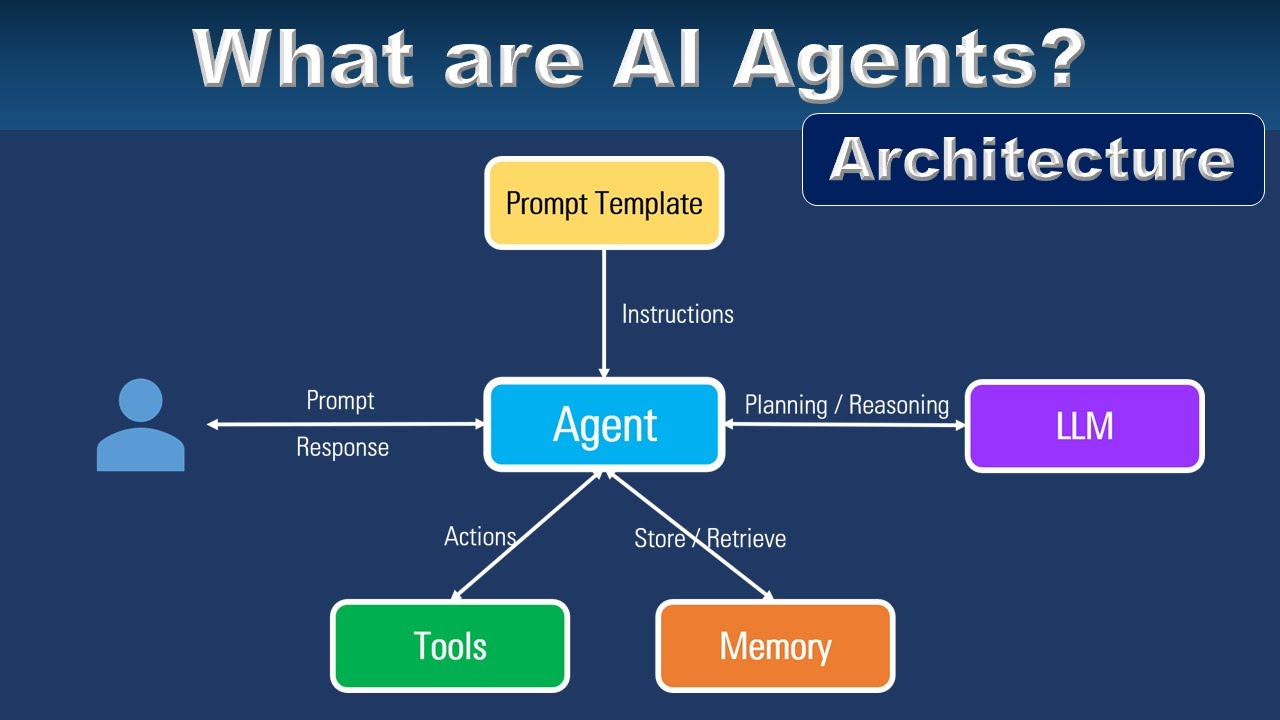
A decade ago, artificial intelligence was like a gifted intern — great at following instructions but limited when thrown into real-world chaos. Fast forward to today, and we’re seeing a different breed altogether: AI systems that can read the room, connect the dots, and take initiative. At the heart of this leap? AI Agent Architecture.
It’s the framework that shapes how intelligent agents perceive, reason, remember, and act. The better the architecture, the better the agent — whether it’s managing a hospital’s patient flow, running predictive maintenance in a factory, or assisting a customer through a late-night troubleshooting session.
So, what makes modern AI agent architecture so different? It’s not just about raw intelligence anymore; it’s about building systems that are context-aware, adaptable, and reliable under unpredictable conditions.
From Static Intelligence to Living Systems
In the early days, AI models felt like locked boxes. Feed them data, get an answer, end of story. But business environments rarely operate in neat, predictable cycles. Data changes by the second, customer needs shift mid-interaction, and market signals can swing from calm to volatile overnight.
Modern AI agents work differently. They’re designed to continuously absorb new information, evaluate their surroundings, and make decisions as situations evolve. If the older models were calculators, today’s agents are more like experienced project managers who can improvise without losing sight of the goal.
The Four Pillars of Modern AI Agent Architecture
Regardless of industry, most effective AI agents are built on four foundational layers. Think of these as the “organs” of the system — each vital in its own way.
1. Perception Layer
This is how the agent senses the world. It could be customer messages coming through a chatbot, temperature readings from a sensor network, or stock price feeds updating in milliseconds. The quality of perception determines how well the agent can interpret reality — garbage in, garbage out still applies.
2. Reasoning & Decision-Making
Here’s the thought process. Modern AI agents don’t just respond to triggers; they weigh multiple possibilities before acting. Using planning algorithms, logic models, or hybrid neural-symbolic systems, they decide not just what to do, but why it’s the best move in the moment.
3. Memory Systems
Ever dealt with a support agent — human or AI — who forgot what you said five minutes ago? Frustrating, right? That’s why memory matters. Short-term memory helps agents keep track of ongoing interactions, while long-term memory lets them learn from past experiences. In healthcare, for example, memory enables a diagnostic AI to refine its recommendations based on thousands of prior cases.
4. Action Layer
Once a decision is made, the action layer makes it happen. That might mean sending a notification, adjusting a machine setting, or initiating a workflow in another system. This is where all the thinking turns into tangible results.
Why Context-Awareness Is the Real Game-Changer
A “smart” agent that ignores context can easily make blunders. Imagine a smart home assistant turning on the lights at full brightness… while you’re hosting a movie night.
Context-awareness means the agent understands not just what is happening, but what it means in the bigger picture. This requires:
-
Dynamic data fusion – blending live sensor data with historical records.
-
Adaptive reasoning – altering strategies mid-task based on unfolding events.
-
Predictive modeling – anticipating what’s likely to happen next and preparing for it.
When done well, this turns an agent from a rule-follower into a proactive problem-solver.
Popular Architectural Patterns in the Field
While no two AI systems are identical, certain design patterns show up repeatedly in successful deployments:
-
Reactive Architecture – Lightning-fast responses without complex planning. Ideal for real-time systems like intrusion detection.
-
Deliberative Architecture – Slow and strategic, using an internal model to plan ahead. Often used in autonomous navigation.
-
Hybrid Models – A balance of the two, combining the quick reflexes of reactive systems with the foresight of deliberative planning.
-
BDI (Belief–Desire–Intention) – Inspired by human psychology, this approach keeps a running model of the world (beliefs), desired outcomes (desires), and committed plans (intentions).
Hybrid and BDI models have been gaining ground because they handle both routine operations and complex, unexpected scenarios gracefully.
How AI Agent Architecture Translates to Real Impact
The architecture might sound abstract until you see it in action:
-
In Retail: AI agents monitor customer browsing behavior, adjust promotions on the fly, and coordinate stock replenishment without waiting for human intervention.
-
In Manufacturing: Predictive maintenance agents detect subtle anomalies, schedule repairs, and ensure minimal downtime — often saving millions in avoided losses.
-
In Finance: Fraud detection agents spot suspicious activity and respond in real time, adapting their detection strategies as criminals change tactics.
-
In Healthcare: Triage agents prioritize urgent cases, assist with diagnostics, and recommend treatments tailored to patient history.
These aren’t futuristic concepts. They’re happening right now in forward-thinking organizations.
The Tough Part: Engineering Challenges
Building an AI agent architecture is one thing; making it robust in the real world is another. Common hurdles include:
-
Scalability: Can the system handle a sudden spike in requests without collapsing?
-
Data Governance: Especially in regulated sectors, privacy and compliance can’t be afterthoughts.
-
Coordination in Multi-Agent Systems: When multiple agents work together, they need clear protocols to avoid working at cross purposes.
-
Explainability: Decision-makers increasingly expect AI outputs they can understand — not just “black box” answers.
The Road Ahead: Self-Improving Agents
Looking forward, the frontier lies in agents that refine themselves over time. Using feedback loops, reinforcement learning, and advanced memory architectures, these agents will continuously upgrade their own reasoning capabilities without requiring complete human-led retraining.
We’re also seeing the rise of Model Context Protocols (MCP) for more nuanced memory handling, and multi-agent ecosystems where specialized agents collaborate — much like cross-functional teams in a company.
Final Take
Modern AI agent architecture isn’t just a diagram in a whitepaper — it’s the invisible framework that determines whether an AI system feels like a clunky automation script or a trusted partner in problem-solving.
When designed with context-awareness, adaptability, and clear reasoning paths, these architectures empower agents to deliver real-world impact. And in an era where every business is chasing efficiency, foresight, and personalization, that’s not just a technical advantage — it’s a competitive one.