


Is your hospital still struggling with long call wait times, missed appointments, or poor patient follow-ups?
Overcome such issues by integrating a smart digital assistant, such as an AI Chatbot, in healthcare.
An AI chatbot in healthcare automates appointment scheduling, enabling diagnosis and answering general questions. Freeing up
your staff and improving patient satisfaction.
In this guide, we’ll break down how hospitals are using chatbots, why they’re effective, and what value they bring to your digital transformation efforts.
The Growing Significance of AI Chatbots in Healthcare

Let’s first examine the growing demand for AI in healthcare.
The global AI health market was valued at $15.1bn in 2022. By 2030, it’s expected to reach $187.95bn, growing at an impressive 37% compound annual growth rate (CAGR).
So, what does it mean for your healthcare services?
AI chatbots in healthcare are not just for symptom checks. They’re smart, reliable, and always available, helping you streamline care, improve patient guidance, and free up your team for higher-value tasks.
Here’s how they make an impact:
- Patients stop Googling symptoms and start getting structured, verified guidance.
- Even outside office hours, patients get immediate help.
- Bots collect basic info and route patients to the right care.
- Patients are guided to the best channel for their situation.
- Your team spends less time answering repetitive queries.
- Fast, accurate responses build credibility with your patients.
- Automation reduces wait times and improves workflows.
How Healthcare Chatbots Work and Why It Matters?
Healthcare chatbots use Natural Language Processing (NLP), the same tech behind Siri or Cortana, for AI automation, which helps understand what people say or type.
This makes them even better is machine learning. ML helps them improve over time. The more they interact, the smarter they get.
Chatbots on hospital websites or apps provide patients (and attendants) with quick answers at any time.
As a result, they can: AI automation services
- Understand and respond to patient queries
- Interpret medical context and intent
- Learn from past interactions
- Offer personalized health information
This AI automation service enables healthcare providers to offer more efficient patient support without adding to staff workload. Chatbots are now advanced enough to serve various roles in clinical and non-clinical settings.
Types of Healthcare Chatbots
Not all chatbots are the same. From improving communication to guiding treatment to sharing updates, here are the three main types you should know:
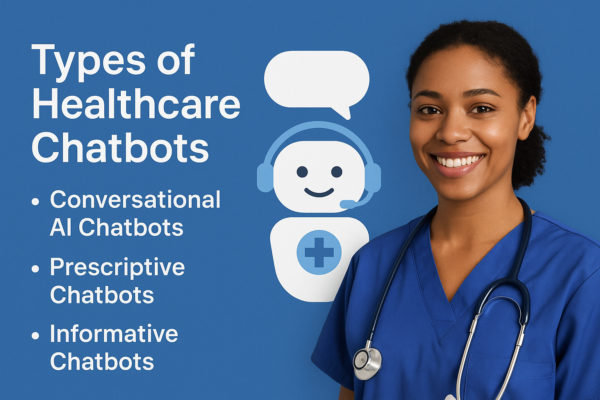
1. Conversational AI Chatbots
Healthcare chatbots are at their core of conversational AI. These chatbots use AI to understand patient questions and respond just like a human would.
They’re great for:
- Handling patient FAQs
- Booking appointments
- Symptom checking
- Triage assistance
2. Prescriptive Chatbots
Offer personalized advice or care guidance to patients, addressing their needs of hours. Based on input, they can:
- Suggest treatment options
- Provide medication schedules
- Guide therapy or mental health exercises
3. Informative Chatbots
These bots are designed to send quick, helpful information; they share reminders, tips, and health updates. They’re best for:
- Sending medication reminders
- Sharing health tips and medical
- Providing updates about treatments or research
The right chatbot selection can improve care, save time, and make communication more efficient.
Understanding the Use Cases of Chatbots in the Healthcare Industry
AI in healthcare industry is gaining popularity, and chatbots have already demonstrated value in several key applications.
Here are some prominent use cases that highlight their potential:
1. Symptom Assessment
Patients who Google symptoms of a probable disease often receive vague and inaccurate results. Chatbots may offer structured assessments, reducing unnecessary doctor visits and guiding users to proper care channels.
Key offerings:
- Ask health questions for AI symptom analysis
- Suggest self-care or professional follow-up
- Use NLP for layman’s medical descriptions
- Provide pre-diagnosis support for non-critical issues
- Alleviate ER congestion with early digital triage
2. Administrative Assistance
Chatbots automate manual tasks like:
- Appointment
- Reminders
- Prescription management
The free time can be used for more critical work.
Key offerings:
- Schedule or modify appointments in chat
- Send automated check-in and refill reminders
- Assist patients with registration and forms
- Answer administrative questions 24/7
- Integrate with EMRs for real-time updates
3. Instant Patient Query Resolution
Patients don’t want to spend time calling hospitals or reading FAQ pages. Chatbots with provide real-time responses to help improve service speed and satisfaction.
Key offerings:
- Answer insurance questions with up-to-date policy info
- Share hospital hours and specialist availability instantly
- Offer billing breakdowns and accepted payment methods
- Guide users to the nearest labs or service points
- Handle multilingual queries for diverse patient bases
4. Billing & Insurance Support
Many patients and their caregivers get confused by medical bills and insurance paperwork. Chatbots simplify it, leading to fewer errors and better transparency.
Key offerings:
- Simplify medical bill explanations
- Guide users through filing insurance claims
- Track claim status and update patients
- Provide pre-authorization info based on provider networks
- Reduce helpdesk burden with smart claim guidance
5. Research and Treatment Support
Doctors can’t stay updated on every new treatment. Chatbots streamline access to research and provide decision-making support.
Key offerings:
- Curate the latest research based on specialties or conditions
- Highlight experimental therapies for complex patient needs
- Recommend treatment guidelines from verified medical sources
- Offer personalized info on side effects and outcomes
- Support doctors with AI-backed care recommendations
6. Post-Care Monitoring & Patient Follow-Up
Patients need post-care monitoring after discharge. With a medical AI chatbot, patients can continue engagement, improving outcomes and reducing readmission risks.
Key offerings:
- Monitor symptoms and medication adherence remotely
- Alert doctors to sudden changes in patient condition
- Log vitals and feedback from wearable health devices
- Send wellness tips and daily progress check-ins
- Enable patients to report side effects or complications
7. Request Medical Records
Patients sometimes need fast access to their medical records. Instead of waiting on hold, they can ask an AI chatbot.
Key offerings:
- Digital lab reports and visit summaries
- Real-time processing to reduce delays
- EMR integration for seamless access
- Multilingual support for diverse patients
Key Benefits of Healthcare Chatbots
AI-enabled chatbots offer numerous advantages to both healthcare institutions and patients:
1. Improved Patient Access
24/7 availability ensures patients can access information and support anytime, breaking the constraints of traditional office hours.
2. Automated Information Delivery
Instant responses to common queries streamline patient interactions, providing accurate information without delays.
3. Cost Efficiency
Automation of appointment scheduling, prescription refills, and other routine tasks reduces administrative burdens and operational costs.
4. Simultaneous Multi-Patient Engagement
Managing several inquiries at once without losing quality improves service during busy times.
5. Enhanced Scalability
Easily scale services to handle more patients without needing more staff.
AI chatbots in the healthcare sector can significantly improve patient engagement and satisfaction. By addressing common challenges with innovative solutions, healthcare providers can deliver more responsive, efficient, and patient-centered care.
Be a Part of the Revolution of AI Chatbots in Healthcare
Your patients want faster answers, fewer forms, and easier access to care. And your staff wants more time to focus on what matters.
- Chatbots can help with both.
- Thinking about giving it a try?
Start with a Chatbot development service partner with extensive knowledge of the healthcare sector. Get a chatbot that fits your workflow, respects privacy laws, and grows with your needs.