

How AI is Becoming the Silent Watchdog for Safer, Smarter Healthcare

Have you ever wondered who watches over patients when nurses step out for a minute, or when the room goes quiet at night?
Hospitals are bustling during the day, sure. But what happens in those hidden, unsupervised moments? A patient could fall while trying to reach the bathroom, remove a vital IV line, or wander off the ward entirely.
It’s not just about being “watched”—it’s about being protected, even when no one’s there.
That’s where computer vision (CV) steps in. Not as a spy. Not as some sci-fi robot doctor. But as a quiet, invisible layer of support—always watching for signs that something’s not quite right.
Let’s talk about how this tech is making hospital stays safer, smarter, and maybe even a little more human.
A Late-Night Fall That Changed Everything
Back in 2019, my friend’s grandmother had a fall in the hospital. Middle of the night. She tried to get out of bed, tripped over the oxygen tubing, and hit her head. There were no alarms, no alerts. A nurse found her twenty minutes later.
That was the moment her family started asking: “Isn’t there some technology that could’ve caught that?”
Turns out—yes. And it’s here, right now.
So, What Is Computer Vision in Healthcare?
Imagine a camera system that doesn’t just record… but actually understands what it’s seeing.
Computer vision uses AI algorithms to analyze video footage in real time. It can detect motion, body posture, facial expressions, gestures—and even identify specific actions like falling, pacing, or lying still for too long.
It’s like giving cameras a brain.
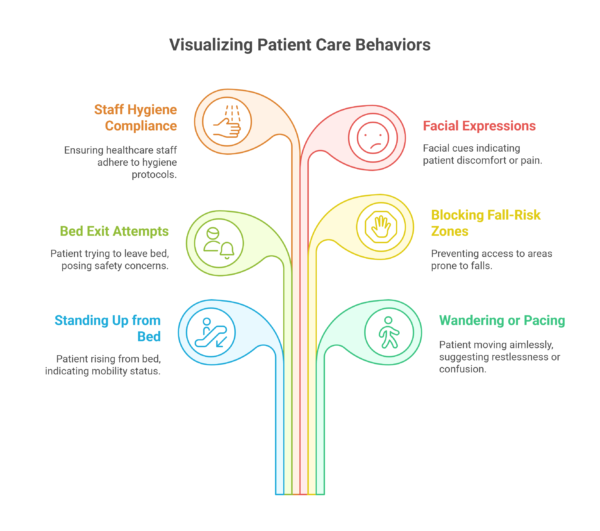
Use Cases of Computer Vision in Monitoring Patient Behavior
So, how exactly is computer vision being used in hospitals right now? Let’s break it down into real, everyday scenarios—no names, no jargon, just straight-up how this tech helps.
1. Preventing Patient Falls Before They Happen
Computer vision systems monitor patients in real-time to detect when someone tries to get out of bed—especially those labeled as a fall risk. If a patient begins to sit up, swing their legs off the bed, or lean forward in a way that indicates they’re about to stand, an instant alert is sent to nearby staff. This can prevent accidents before they happen.
2. Detecting Wandering and Unsafe Behavior
For patients dealing with memory issues or confusion, CV systems can recognize wandering behavior—like pacing, repetitive movement, or heading toward unauthorized areas. These alerts help staff intervene quickly to prevent patients from getting lost, hurt, or entering restricted zones like stairwells or utility rooms.
3. Monitoring Movement in Isolation Rooms
In rooms where patients require limited human contact (such as during infectious disease protocols), computer vision can track posture, movement, and physical distress. If someone slumps over, collapses, or shows erratic movement patterns, the system can trigger an emergency alert—without the need for constant in-person monitoring.
4. Identifying Patient Distress Without Words
Not all patients can call for help. Some may be non-verbal, unconscious, or too weak to use a call button. CV can be trained to detect signs of physical discomfort or agitation—like rapid movements, facial grimacing, or sudden restlessness—allowing staff to respond even if no alarm is triggered.
5. Observing Sedation and Micro-Movements in ICUs
In intensive care units, computer vision helps monitor patients under sedation or in delicate post-surgical recovery. Small changes in movement, body position, or eye fluttering can be tracked, providing insight into a patient’s responsiveness or the need for repositioning, suctioning, or intervention.
6. Tracking Sleep Patterns and Bed Rest Compliance
CV systems can log how long a patient stays in bed, when they toss and turn, or if they’ve remained in one position for too long. This is vital for patients at risk of pressure ulcers or deep vein thrombosis and helps caregivers adjust care schedules more precisely.
7. Ensuring Proper Hygiene Protocols Are Followed
Some systems are equipped to detect whether healthcare staff perform hand hygiene before entering or exiting a room. They can also monitor the correct usage of masks, gloves, and gowns. This supports infection control practices without needing manual logs or supervision.
8. Monitoring Aggressive or Dangerous Behavior
In psychiatric units or with certain high-risk patients, CV can identify erratic, aggressive, or self-harming behavior. This includes pacing, rapid arm movement, attempts to pull out IV lines, or hitting objects. Early detection can prevent injuries to patients and staff.
9. Alerting to Lack of Movement or Prolonged Inactivity
If a patient stops moving entirely for a concerning period of time—especially when not asleep—CV can trigger an alert. This may indicate unconsciousness, a stroke, or other medical emergencies requiring immediate attention.
10. Supporting Post-Surgical Recovery and Rehabilitation
In recovery settings, CV is used to monitor whether a patient is following their physical therapy regimen correctly. It can detect if they’re walking unsteadily, favoring one side, or not moving enough—all indicators that might require medical review or adjustment to their care plan.
Is This Replacing Human Care?
Nope. It’s enhancing it.
Nurses are some of the hardest-working people in the world. But they can’t be in 10 rooms at once. Computer vision is like their silent assistant, quietly watching and whispering: “Hey, Room 203 might need you right now.”
Instead of spending hours on routine check-ins that might not be needed, nurses can prioritize real issues. That’s not less care—it’s better care.
Hygiene Monitoring? Oh Yeah, It Does That Too
Some CV systems are even watching staff hygiene compliance. Yup—making sure doctors and nurses sanitize hands before entering and exiting rooms.
Before you go “Big Brother much?”—remember, this isn’t about spying. It’s about protecting patients from infections like MRSA or C. diff, which are way too common.
The Real Magic: Behavioral Prediction
CV isn’t just reacting—it’s beginning to predict.
Using deep learning, these systems can start to recognize patterns that lead to problems before they happen. For example:
-
A patient who paces more frequently at night may become delirious by morning.
-
Subtle facial movements may indicate pain before the patient even says a word.
-
Bed rest patterns might signal a need for pressure ulcer prevention.
Think of it as AI intuition, backed by thousands of hours of data.
Let’s Talk About Privacy & Ethics
Okay, here’s the elephant in the room. Cameras in hospital rooms? Doesn’t that feel… weird?
Yes—and no.
First off, most CV systems don’t record video. They process it in real-time and delete it instantly. They don’t store footage or facial recognition data unless specifically designed to. And many hospitals give patients the option to opt in.
The key is transparency. Patients deserve to know what’s watching them, why, and how their data is being used.
There’s also a strong need for bias-free training data—so the systems work equally well on people of all races, body types, and ages.
What Are Nurses Saying?
Honestly? Many are relieved.
They’re still the heart of care—but now they have tech that helps them be in the right place at the right time. It’s not about replacing instincts—it’s about supporting them.
What About the Tech Behind It?
Want a peek under the hood? (No jargon, promise.)
Most CV systems use:
-
YOLO (You Only Look Once) or similar object detection models
-
Pose estimation algorithms to understand how a person is standing, sitting, or moving
-
Activity recognition models that learn from thousands of hours of labeled hospital footage
The hardware? Just high-quality cameras + edge computing to analyze data locally. Sometimes even thermal imaging is used for night-time monitoring without waking patients.
So, What’s Next?
The future of CV in hospitals is wild—in a good way.
Expect to see:
-
Multi-modal AI combining vision + sound (e.g., detecting cries, coughs, or breathing anomalies)
-
Wearable-integrated CV that syncs with patient vitals
-
Emotion recognition to support mental health and pain assessment
-
24/7 home-based monitoring for patients recently discharged from hospitals
Eventually, this tech won’t just see what’s happening. It’ll understand what might happen—and help prevent it.
Final Thoughts: Is Computer Vision the Future of Patient Safety?
Not the future. The present.
If used ethically, transparently, and wisely, computer vision in healthcare won’t just make hospitals smarter—it’ll make them kinder. Because true healthcare isn’t only about curing diseases—it’s about protecting people, even when they’re too weak, scared, or tired to ask for help.
So next time you walk into a hospital room and notice a tiny camera above the door, remember—computer vision in healthcare might just be the most attentive nurse in the room.