
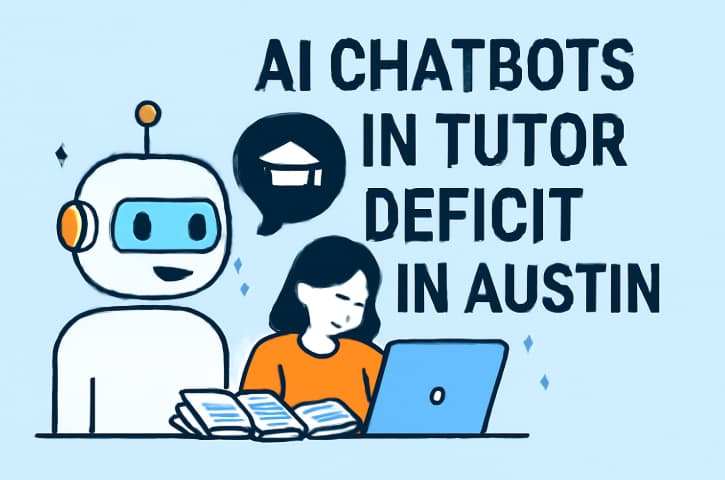
Austin Public Schools, like many districts across the country, have been grappling with an acute shortage of tutors ever since the pandemic raged on. As an example, in 2022, 72% of schools in the Austin ISD (Independent School District) operated under severe resource allocation and student-level servicing backlogs. Title I schools were the most overburdened. Further complicating matters, Austin’s ESL and bilingual programs experienced a disproportionate 19% increase in enrollment since 2020, exacerbating understaffing issues.
To combat these problems, AI chatbot development services are being utilized. Austin ISD is engaging with adaptive and STEM chatbots to partially fulfill the staffing voids left by STEM adult educator tutors, language tutors, or IEP meeting compliant subject tutors. Some Austin-based software development companies that operate under FERPA data security restrictions and personalized, scalable algorithms are building these chatbots. For instance, TEKS-standard trained chatbots now assist more than 8000 ESL students within the district.
Solving the Tutor Shortage Problem in the Austin Independent School District
Analyzing the Vanishing Tutors Issue in Austin’s Education
Austin ISD serves an astonishing 74,000 students enrolled across 129 school campuses. From this number, about 42 percent are from low income families.
Within the district, there is an allocated budget of more than six percent of more than $100 million specifically reserved for tutoring services within the district. Given the inflation and rising demand, even this figure could not seem enough when looked at from the perspective of the total annual budget of $1.9 billion. These shortfalls stem from mid-pandemic for the following three reasons:
-
Impact of the Pandemic on Learning
-
- The results from the STAAR assessments show that a greater proportion of students below grade level are gaining comprehension skills for the first time, and gaining the ability to read during Austin ISD’s FY 2023, than those who have already mastered these skills.
- As for the 3rd graders, the improvement in their supposed middle school level reading and math skills comes along with a decline in reading proficiency of 11% creating a self-sustaining downward spiral.
2. Exceeds ESL Service Capacity
- Austin ignores the requirements of ESL and bilingual learners. Among 28,000 learners within the district, only 1200 district tutors are trained to provide specialized instruction in English as a Second Language, bilingual education, and ESL tutoring.
- Given that 82% of these learners are Spanish, the available proportionate Spanish speaking tutors is drastically limited because fewer than 30% of them identify as Spanish speakers.
3. Compliance Requirements for the IEPs
Within the district, the estimated population of students with disabilities served by IEPs sits around 14%, this includes directed teaching for dyslexia and autism spectrum disorder.
How AI Chatbots are Changing Classrooms in Austin
Integration and Holistic Offbeat Learning Approaches
There is a 37% increase in tutoring hours tracked to IEPs along with an increase in overall tutoring. This suggests a growing shift towards IEP-centered tutoring among specialized instructional staff.
The Austin Public Library alongside UT Austin College of Education collaborated with the district, yet their people-centered methodologies relied on algorithms which are ineffective in solving problems at a broader level.
As showcased by Midwestern Generative AI, taught real-time generative AI tutoring with algorithms can fill in the gaps in instruction.
Like this:
For example:
-
Encouragement Of ESL Students
“A Software Development Company In Austin” implemented pedagogical chatbots for the bilingual SAT review in Spanish and Vietnamese grammar and vocabulary quizzes. ESL learners are assisted by these chatbots. Navarro Early College High School reported an 18% improvement in ESL students’ writing scores after one semester of chatGPT instruction. Writing scores increased 18%.
-
Compliance With IEPs:
All relevant reading fluency exercises integrated IEP goals and teaching targets within the chatbot frameworks. Alerts are sent to (Name) at the paragraph level to where students drown out reading. For those with dyslexia, mathematical response chatbots can answer simply. Autistic students could be given pictorial answers.
-
STEM Subjects Supported: Chris-shot And Drone Racing
Teaching assistant chatbots at code.org monitor students in workshops and converse with them. The seventh graders from Lamar Middle School Champlain showed a 40% increase in autonomy over robotics tasks after receiving teaching aide instruction.
Tracking Active Participation, Engagement Metrics, and Help with Homework
Creating personalized assignments for one or two students based on analyzed engagement levels uses AI, thus automating this work, reducing workloads for teachers.
-
Connection with Google Classroom
Using Sketch Engine, students may be asked to outline essays and chapters or create algebraic sketches that are accessible through chatbots.
At Eastside Memorial High School, for example, 63 percent of students surveyed stated that the use of chatbots enabled them to complete their homework in record speeds.
-
Monitoring Educational Engagement
The uses of Chatbots extend well beyond teaching. With Nearpod, the retrieval feature can be used to monitor educational attendance as well as track participation to pinpoint learners who may have become unmotivated.
For instance, when students skip an attempt at a science quiz, the system identifies that profile-based action plans require counselor assignment.
Austin’s ESL Shift Demographics: Multilingual Support
In 2023, Austin ISD piloted a program with Spanish-speaking chatbots for 9th-grade biology classes. The resulting data included:
- ESL students’ test scores increased by a staggering 33%.
- Homework-related anxiety dropped by nearly 89%.
- There was also a 50% drop in the number of tutors hired for the after-school program.
AI Chatbot Technology Use Cases: Deployment and Integration
Austin ISD’s Pilot Program with Leverly Tech
In 2022, Austin ISD partnered with Leverly Tech, an Austin-based Software development company that deployed chatbots to six Title I schools. Along with these implementations, the following data were reported:
- Navigational Math Skills: 7th graders at Martin Middle School showed an advantage of 14 points over their peers from non-pilot schools, which is a 22% improvement in math achievement compared to non-pilot schools.
- Grading Efficiency Gains: 76% of teachers who implemented chatbots for report assessment and grading experienced a decrease in workload by approximately 2-3 hours per week.
- Material Retrieval for Lessons: Chatbots retrieved lesson materials from Khan Academy and Quizlet within the Canvas LMS.
Chatbot Effectiveness Evaluation at UT Austin
In 2023 The College of Education at UT Austin evaluated the performance of chatbots as tutors for physics at Austin ISD.
The outcomes of the report were:
Improving Student Engagement and Utilization of Chatbots: Student Insights
Utilization: Students attending from lower socioeconomic classes engaged with the mobile tutor’s after-hour sessions resulting in 50% improvement in utilization.
Higher Order Skills: Chatbot learners mastered higher order skills better and self-solved problems related to momentum and energy with a 40% improvement over their prior attempts.
AI Chatbots Compliance Review For Austin School Applications
Proposed Actionable Initiatives For Schools In Austin
Data Privacy Compliance for Chatbot AI Solutions under FERPA for Educational Use
With respect to Generative AI Development services, the outlined frameworks must securely bound the school client’s user privacy:
- Protection of Confidential Information: As an instructional aide, Microsoft Teams satisfies student data protection for educational tools through end-to-end encryption, satisfying protective confidentiality obligations.
- Compliance with Audit Trails: ClassDojo’s log access functionality provides streamlined compliance with audit trail TEA requirements.
Integration of The Chatbot With The Existing Technology Framework
For Google Classroom: Custom programmed chatbots can reply based on dynamic engagement through assignment criteria on designated dates.
A Google Partner Integrator situated in Austin develops custom solutions for:
Google Classroom
Programmable chatbots for Google Classroom which can interact on specific dates and meet certain assignment requirements.
Clever API
Automatic fetching of student and IEP roster data.
Canvas LMS
Responsive Book providing automated essay critique services offers real time feedback during the drafting process utilizing advanced Grammarly-like features for iterative improvement.
Community Engagement and Professional Development
Annually, The Ed Fund spends 500,000 dollars on projects related to AI in education.
In addition, it offers workshops such as:
- Engagement Analytics: Activity driven feedback from students helps educators tailor lessons.
- ChatGPT Assisted Guided Reading: Group reading sessions with emerging students where instruction is funnelled through a chatbot.
The gap within the disparity of people’s understanding of AI tools and their use, is diminishing.
Strategy And Solutions
Above Ethical Boundaries Innovative Solutions
Let’s consider AI tools applied in education. What is more, ethical standards seem to vanish in thin air when effectiveness is measured:
- Screen Time Limits: In the case of kindergarten and elementary students at Austin ISD, there is a new daily limit of 30 min chat back time.
- Supervised Interactions: AI suggested IEP modifications. These were approved by a special ed teacher who monitored the implementation weekly.
Chatbots help students with creative writing and dialogue work where they were absent through Moodle.
Shifts in Learning Models in Austin and the Effects of Artificial Intelligence Technologies
New innovations include:
- Voice-guided AI Tutors: At Crockett High, Alexa For Education is being piloted with 10th grader Roku, who is blind and learning chemistry through visualization.
- AR With Chatbots: Students can interact with three-dimensional geometric shapes during their mathematics lessons using chatbots powered by Nearpod’s AR.
AI systems are being developed to assist in dyslexia with the Texas Education Agency’s goals for 2025 inclusivity, and local sponsors like EduBot Austin are driving these initiatives forward.
Final Thoughts
Austin’s educational environment is transforming with the introduction of AI-enabled tutor gap-filling technology. This growth is propelled by freelance adherence to FERPA and IEP within educational chatbot framework compliance. Work with Austin software development companies focuses on tech serving ESL to alleviate instructor burnout, chronic educator shortfalls, and systemic underperformance.
Common Inquiries
Are AI chatbots compliant with FERPA?
They are compliant. Prominent Austin software development companies arm their chatbots with FERPA-compliant legal schematics, RBAC roles, protective encapsulation exo-skeletons, and PARC shielded counter measures. To illustrate, the Austin ISD chatbots are audited by TEA annually.
Can human tutors for ESL students be substituted with chatbots?
There are still some questions that remain unexplored or unanswered.
Regarding the culture mentorship, ESL tutors focus on speaking for conversation practice, whereas chatbots are strictly used for grammar exercises.
What are the costs associated with chatbot systems for Austin ISD?
The estimated cost to Austin Ed Fund for their pilot programs is between $15,000 to $25,000 per school. These pilot program costs are subsidized by grants from Austin Ed Fund, which cover 60-80% of the total costs.