
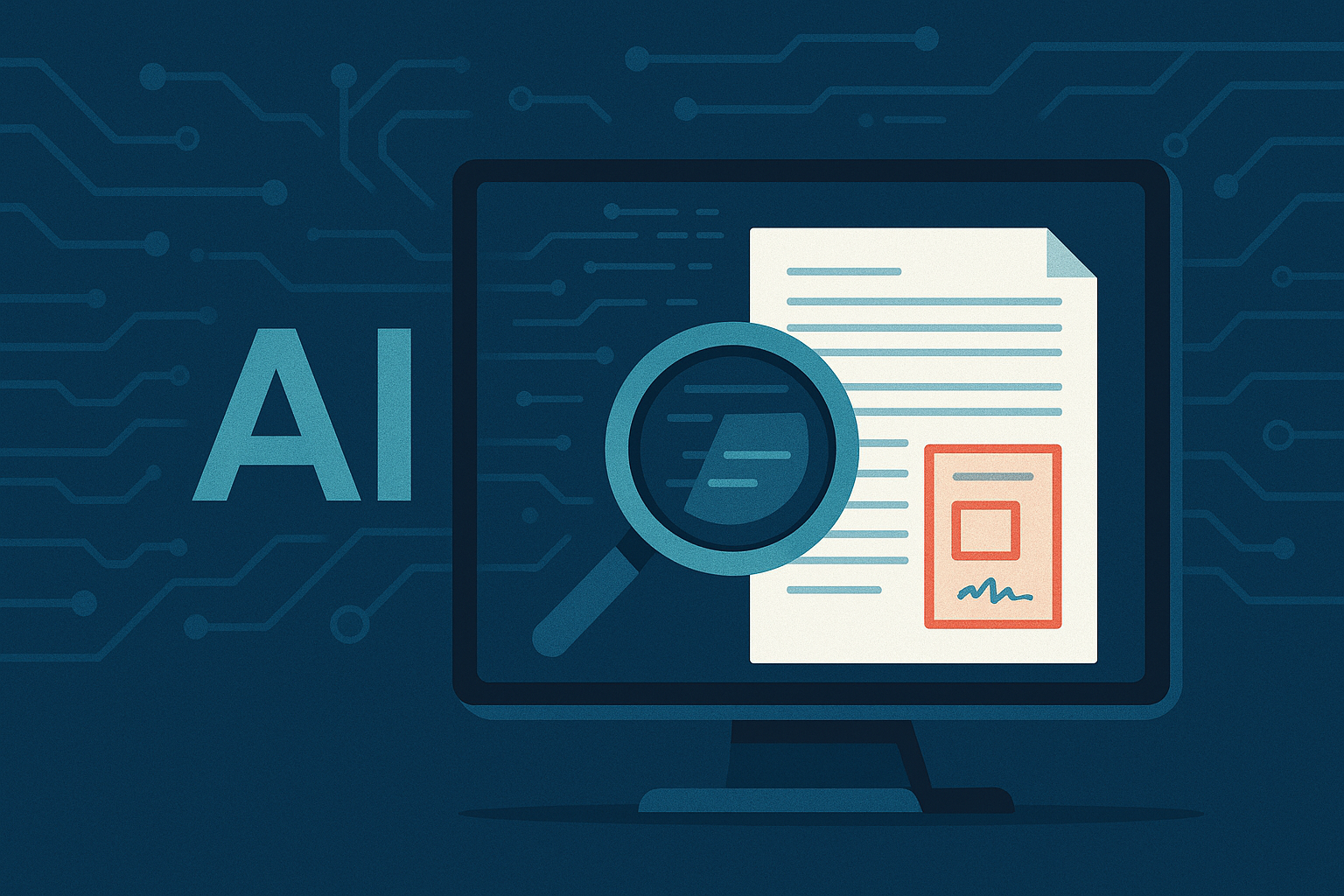
Back in the day, committing document fraud was a slow, manual job – think forged passports or tampered paperwork for immigration. Today, with generative AI and advanced image editing tools, even the trained eye can struggle to tell real from fake.
The bad news: Document fraud is now fast, scalable, and alarmingly convincing, often powered by the same AI tools used in everyday business.
From fake invoices to manipulated IDs, fraudsters are automating their way in, bypassing traditional checks. And it works because most legacy systems can’t keep up because they rely on static, hardcoded rules, not real-time analysis.
The good news: Machine learning can fight back. At scale.
Instead of ticking boxes, machine learning identifies patterns, detects subtle anomalies, and gets smarter over time. It can flag inconsistencies a human might miss, such as mismatched fonts, suspicious metadata, or reused design elements.
In this article, we’ll break down how machine learning spots document fraud, the techniques it uses, and why it’s becoming essential for modern fraud prevention.
Why Legacy Fraud Detection Systems Fall Short
Many traditional fraud detection systems use fixed rules and immutable templates. So if an invoice is missing a field or a document doesn’t follow the expected structure, the system flags it. Otherwise, it slips through.
But: that rule-based logic collapses when fraud starts to become dynamic.
Today’s fraudsters use AI and automation to manipulate documents just enough to evade simple checks like changing a total here, tweaking a date there, or reusing parts of legitimate documents to make fake ones even harder to detect.
Here’s why legacy systems struggle:
- They’re fragile: Hardcoded rules literally can’t adapt to new fraud tactics. This means that when a fraudster finds a loophole once, they can exploit it at scale, and they will.
- They’re blind to patterns: They can’t see broader behavioral signals, like whether the same template has been reused across hundreds of submissions.
- They miss the context: Most legacy tools depend on basic OCR (Optical Character Recognition) to simply “read” text from documents, but they stop there. OCR alone simply can’t catch subtle anomalies hidden beyond the visible text.
While AI can now generate fake documents on demand, static systems are simply too slow, too manual, and too easy to outsmart.
To fight back, you need machine learning in your arsenal: using AI to combat AI fraud. And as comical as it sounds, it works.
Why Machine Learning Is a Game-Changer
Unlike legacy systems, machine learning doesn’t rely on rigid rules that fraudsters can sidestep. It adapts, it learns, and most importantly, it gets smarter with every document it analyzes.
Here’s what makes machine learning a true game-changer for fraud detection:
- It’s adaptive: Machine learning models constantly adjust based on new data. If fraudsters find new layouts, new fake signatures, or add slight variations in fonts, the system can catch on without needing a manual rule update.
- It sees what humans (and simple algorithms) miss: Machine learning can detect subtle patterns and anomalies across thousands of documents like slightly off-center stamps, inconsistent lighting across scanned IDs, or unusual combinations of fields that don’t make any sense when placed next to each other.
- It handles scale effortlessly: Whether you’re processing hundreds or millions of documents a month, machine learning maintains a consistent level of accuracy, spotting issues without getting tired, distracted, or overwhelmed like human reviewers.
To put it simply, it’s like giving your fraud detection team a tireless, ever-learning analyst who never sleeps, never misses a detail, and keeps getting better at their job over time.
How ML Detects Document Fraud: Techniques That Work
There are several ways in which machine learning detects document fraud, but the main technique it uses is actually making sense of the documents contextually. However simple it might sound, it’s actually a complicated process that only the tech wizards can understand.
Here are some of the techniques to catch fraudsters in the act:
Visual Anomaly Detection
ML models can detect pixel-level inconsistencies that would slip past human reviewers. Things like mismatched lighting, uneven compression, altered signatures, or copy-paste artifacts can all hint at document tampering.
Template Deviation Analysis
Legitimate documents usually follow strict layouts. Machine learning can learn these structures and flag when something looks “off”, like a missing field, an unusual logo placement, or a resized background.
Of course, there will always be false positives showing up because even legitimate documents aren’t always perfect. But as a safety precaution, this feature can be a lifesaver.
Field-Level Semantic Validation
Sometimes it’s not how a document looks, but what it says. ML systems can be trained to cross-check fields for logical consistency.
For example: spotting an invoice date that’s in the future (unless time travelers exist), a tax ID that doesn’t match the company name, or a suspiciously rounded total, because how often do you see a perfect $1,000.00 invoice?
Cross-Document Comparison
Fraud often happens at scale, so fraudsters have a wider net to maximize their success rates. Machine learning can detect reused templates, reused headshots, or copied signatures across hundreds (or thousands) of submissions, something no (sane) manual reviewer could do reliably.
Behavioral and Contextual Analysis
Beyond the document itself, machine learning also analyzes how the document was submitted: unusual submission times (what were they doing at 03:00 AM?), duplicate device fingerprints, repeated IP addresses, and other subtle patterns that signal organized fraud.
These were some of the ways in which ML can reliably spot document fraud. Let’s now look at some real-world examples of ML fraud detection in action.
Real-World Examples of ML Catching Document Fraud
With machine learning becoming the new standard for detecting document fraud, legacy systems are slowly being replaced by different ML implementations. Here are a few examples:
1. Mismatched Currency on Invoices
An invoice issued by a US-based vendor but listing totals in Euros? Fortunately, ML models can flag these kinds of inconsistencies between the vendor’s registered country and the currency used, which is a telltale sign of fabricated or tampered invoices.
2. Passport Photos That Don’t “Feel” Right
ML-powered image analysis can detect when a passport or ID photo was altered, whether it’s missing the subtle lighting gradients real cameras capture, or if the depth of the field looks artificially flat (common in AI-generated fakes).
3. Recycled Vendors and Layouts
Fraudsters often reuse the same templates, layouts, or vendor details across multiple fake invoices. Machine learning can quickly recognize these duplication patterns across huge volumes of documents, flagging suspicious submissions even if each document looks normal in isolation.
But even with all the power of machine learning, fraud detection isn’t a “set it and forget it” process. There are always edge cases and evolving tactics that no model can catch 100% of the time.
That’s where humans come into the picture, not to replace automation, but to strengthen it.
The Role of Humans in the Loop
Machine learning can catch an impressive amount of fraud, but it’s not a silver bullet.
Fraudsters constantly adapt, and sometimes the difference between a legitimate document and a fake one is too subtle (or too new) for an algorithm to catch on its own.
That’s why humans remain essential in catching document fraud.
In modern fraud detection systems, human reviewers step in to:
- Validate edge cases: When an anomaly is detected but confidence is low, a human reviewer can make the final call.
- Handle high-risk transactions: Critical payments or sensitive documents often require an extra set of trained eyes, no matter how good the AI is.
- Continuously improve models: Human feedback helps retrain machine learning models, making them smarter and more resilient over time.
The best results come not from humans or machines, but from smart automation combined with expert supervision. Together, they create a robust fraud detection system that’s faster, smarter, and harder to fool.
Looking Ahead: The Future of Fraud Detection
As AI tools become more accessible, fraud is no longer clumsy or isolated, quite the opposite: It’s scalable, synthetic, and fast. Fraudsters can now generate convincing fake documents in seconds, meaning businesses need AI document fraud detection tools that are just as adaptive.
Machine learning will continue to be the backbone of modern fraud detection, but it must also evolve. Models will need to get better at spotting synthetic data, learning from smaller clues, and adapting faster than ever before.
At the same time, ethical AI use, transparency, and robust data protection will become non-negotiable. Organizations must build systems that aren’t just powerful, but also responsible and trustworthy.
The future of fighting document fraud isn’t about choosing humans or machines; It’s about combining the best of both worlds. Smart automation, expert oversight, and continuous improvement will be what separates vulnerable systems from resilient ones.
Conclusion
The reality is that document fraud is evolving, and fast. Due to AI, forgeries are no longer rough or easy to spot. They’re scalable, sophisticated, and getting harder to catch with traditional methods.
That’s why machine learning has become essential in modern fraud detection. It doesn’t just apply static rules, but it adapts, learns, and spots the subtle anomalies that humans or rigid systems might miss.
The smartest fraud prevention strategies today don’t rely on humans alone or machines alone. They combine both: using machine learning for speed and scale, and human expertise for judgment and oversight.
As fraud tactics grow more advanced, businesses that invest in smarter, more adaptive fraud detection today will be the ones that stay ahead tomorrow.