
Can AI Steal Spotlight from Human Facial Recognition?
One of the most amazing native abilities of human beings is facial recognition, which has improved by leaps and bounds with advancements in AI. Now that AI-based facial recognition systems have come into being, there is a tide-turning against human capabilities, in the sense of whether the machines can outdo the human brain. Let us try to unravel the topic by discussing “Will AI steal human facial recognition?” with the help of its technology, capabilities, and limitations.
Introduction to AI in Facial Recognition
Facial recognition stands at the crossroads of technology and human cognition. It has revolutionized biometrics for years with unmatched accuracy and unbeatable scalability. From security applications to retail, healthcare, and entertainment, AI-powered facial recognition systems have become essential tools worldwide.
Rise of AI in Biometrics
Will AI Steal Human Facial Recognition? The integration of AI into biometrics has catapulted facial recognition to unparalleled heights. Unlike human recognition, it is bound by fatigue and environmental factors. In contrast, AI systems process vast datasets with precision. The developments in deep learning and neural networks have further improved the ability of AI to detect, analyze, and identify faces across various contexts.
Human Facial Recognition: An Innate Ability
How Humans Recognize Faces
The ability to recognize faces is an extraordinary capacity of the human brain, depending on brain regions such as the fusiform face area (FFA). This capability is of utmost importance for identification purposes, emotion interpretation, and decoding of social cues. Humans outperform in identifying familiar faces even in difficult conditions like dim light or changing appearance.
The Limits of Human Facial Recognition
It’s pretty powerful, yet there are vulnerabilities in the human facial recognition technique. For example, men may easily get tired, people have cognitive biases and tend to recall wrongly. Apart from this, humans cannot find familiar faces, especially when someone goes through security checks under much more stringent procedures.
AI-Driven Facial Recognition: A Revolution
Know the Technology
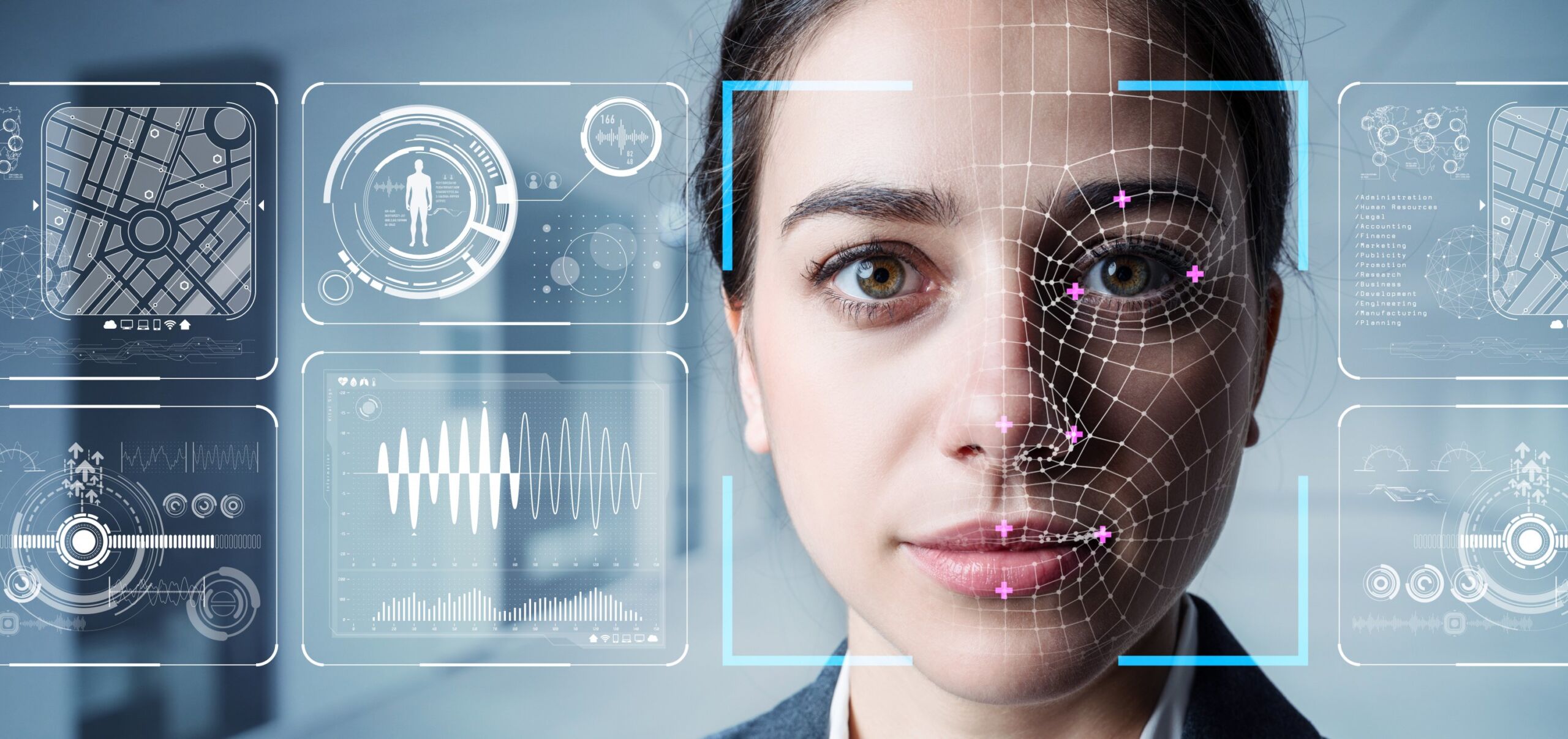
Facial recognition systems based on Artificial Intelligence work on machine learning algorithms that recognize and identify faces. These parts are,
Face Detection: Appearance of face in an image and/or video.
Feature Extraction: Representing unique facial features such as gap between eyes or jawline curvature.
Face Matching: Compare extracted features to a database for identification.
Human v/s AI Face Recognition
Accuracy and Scalability
Speed and Precision are well-suited in AI which, at scales, people can’t outperform. For example, an AI identifies faces within a matter of milliseconds, and in one go it goes through millions of data points while the same is beyond human possibilities.
Problems and Biases in AI Systems
However, AI systems are not immune to errors. Biases in training data can result in the AI making mistakes for the underrepresented groups. Second, adversarial attacks can be fed to the AI system to be confused by manipulations of inputs.
Context and Emotion Recognition
Can AI Understand Emotions Like a Human?
While AI has made strides in emotional recognition, it still lags behind human capabilities in understanding context and subtleties. Humans use cultural, social, and situational cues to interpret emotions, an area where AI struggles to generalize effectively.
Advantages of AI over Human Recognition
Scalability and Speed
AI systems process a tremendous volume of data in real time. This is exactly the kind of application required in handling crowds and border control operations. They don’t get tired or lose concentration as a human does.
Working in Complex Scenarios
AI is better where humans fail. Such examples are faces in a low-resolution picture, partially hidden views, or a huge crowd.
Limitations of AI Face Recognition
Ethical Concerns and Privacy Issues
The deployment of AI facial recognition raises significant ethical questions. Surveillance, data misuse, and privacy violations have resulted in public pushback and regulatory scrutiny.
Susceptibility to Adversarial Attacks
AI systems are vulnerable to adversarial attacks, where small changes in input data—such as wearing specially designed glasses—can mislead the system, compromising security.
Collaborative Potential: Humans and AI Together
Combining Strengths for Better Accuracy
In the meantime, AI can complement human facial recognition. Hybrid systems will combine human intuition with computational power to provide higher accuracy and reliability.
Ethical Considerations and Public Trust
Maintaining Fairness and Transparency
Public trust can be achieved through fairness, transparency, and accountability from developers and organizations in using AI systems. Regular audits, diverse datasets, and transparent policies on usage are essential aspects of ethical implementation.
Conclusion: Complementary or Competitive?
The Future of Facial Recognition Technology
The question, “Will AI steal human facial recognition?” is not a competition but a collaboration. AI systems are set to augment human capabilities in areas where humans struggle and cannot. However, they will always require human oversight to ensure that the application is ethical, accurate, and fair. The future of facial recognition lies in blending human intuition with AI’s technological prowess to create systems that are efficient, reliable, and respectful of individual rights.
This confluence of AI and human capabilities promises a future wherein both can shine uniquely, redrawing the limits of facial recognition technology.